> ## Documentation Index
> Fetch the complete documentation index at: https://docs.usetuner.ai/llms.txt
> Use this file to discover all available pages before exploring further.
# Changelog
> Recent product updates and improvements
Recent product updates and improvements. Have a feature request? Reach out at [feedback@usetuner.ai](mailto:feedback@usetuner.ai).
## July 30, 2026
### 👋 Guided Onboarding & Vapi Latency Precision
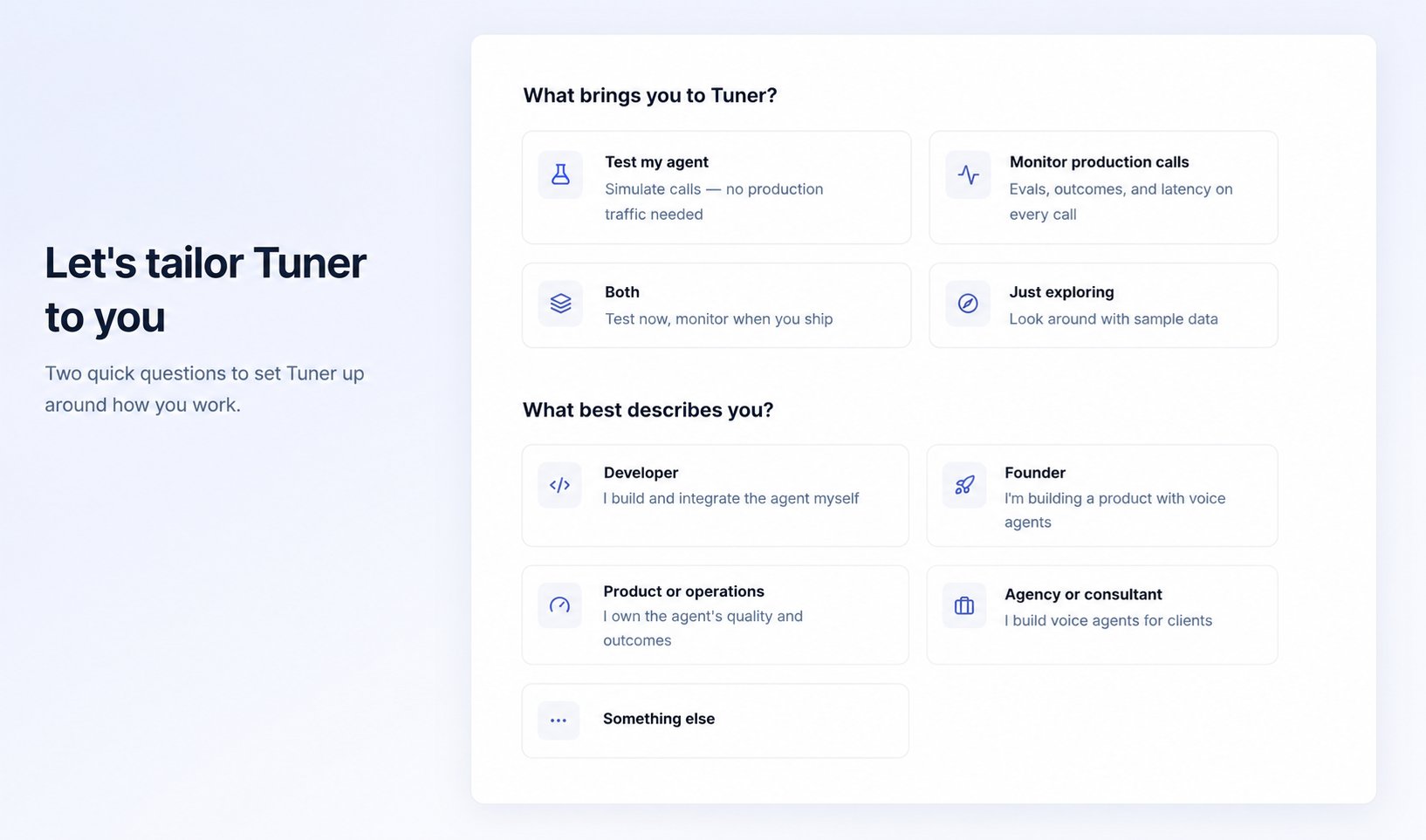
**Guided Onboarding** — New users now start on a welcome page that asks why you're here and what you do, so Tuner can tailor the setup to how you work. Answer with a testing or monitoring goal and you go straight into creating your agent. Pick Just exploring and Tuner sets you up with a demo agent and sample data instead. [Learn more →](/docs/getting-started/quickstart)
**Vapi Latency Precision** — Tuner now reads Vapi's detailed call log alongside the transcript, so latency and interruption timings on Vapi calls match what the caller actually heard. If that log isn't available, the call still comes through from Vapi's summary. [Learn more →](/docs/integrations/vapi)
***
## July 24, 2026
### 🔒 PII Redaction & Enhanced Voice Metrics
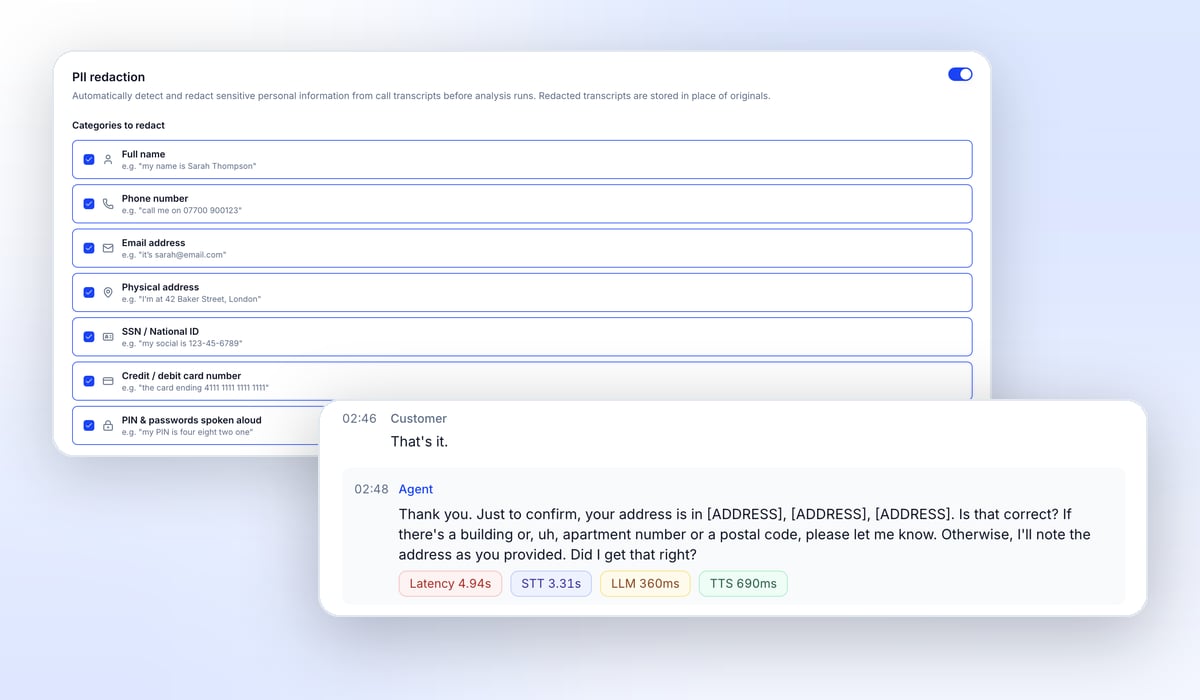
**PII Redaction** — Workspace admins on paid plans can now automatically detect and redact sensitive caller data from call transcripts, so it isn't stored verbatim in Tuner. This helps teams pass HIPAA and GDPR reviews.
* **Clean analysis and evidence** — Because Tuner redacts before it analyzes, your outcomes, intents, evals, and the evidence text they cite all run on clean transcripts. Detected entities become typed placeholders: `[NAME]`, `[PHONE_NUMBER]`, `[EMAIL]`, `[ADDRESS]`, `[SSN]`, `[CREDIT_CARD]`, and `[PIN]`.
* **Nothing sensitive retained** — Tuner stores, analyzes, and displays the redacted transcript. It does not keep the original.
* **Workspace-wide control** — Turn it on in **Workspace Settings → Data & Privacy** and pick which of the 7 categories to redact. The setting applies to every agent in the workspace.
* **Applies going forward** — Redaction is permanent and covers only calls ingested after you enable it. Existing calls stay as they are, and simulation calls are never redacted. [Learn more →](/docs/observability/pii-redaction)
**Enhanced Voice Metrics** — The Voice Metrics card now breaks down turn-taking latency in more detail.
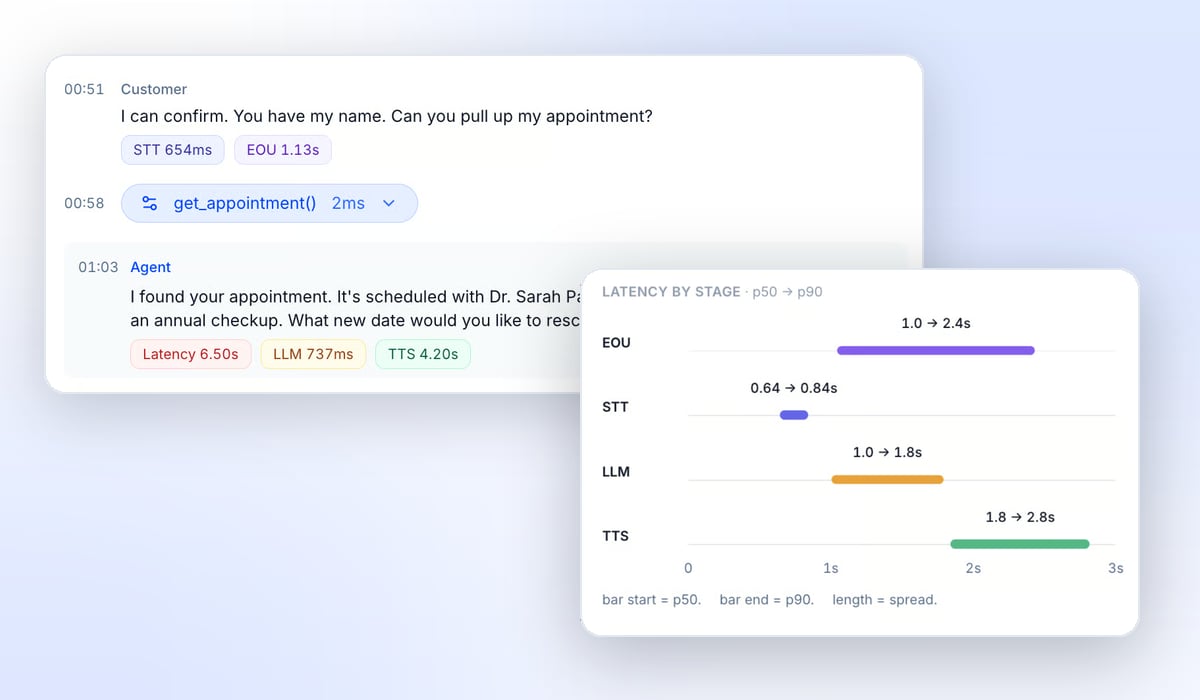
* **Catch awkward pauses** — A new End-of-Utterance (EOU) metric shows how long your agent takes to realize the caller has stopped talking, a common cause of dead air and talking over the caller that the STT, LLM, and TTS timings alone don't explain.
* **Percentile views** — Toggle p50 and p90 to see turn-taking delays in both typical calls and the slow tail. [Learn more →](/docs/observability/voice-metrics)
***
## July 21, 2026
### 🪄 Redesigned Agent Creation Flow
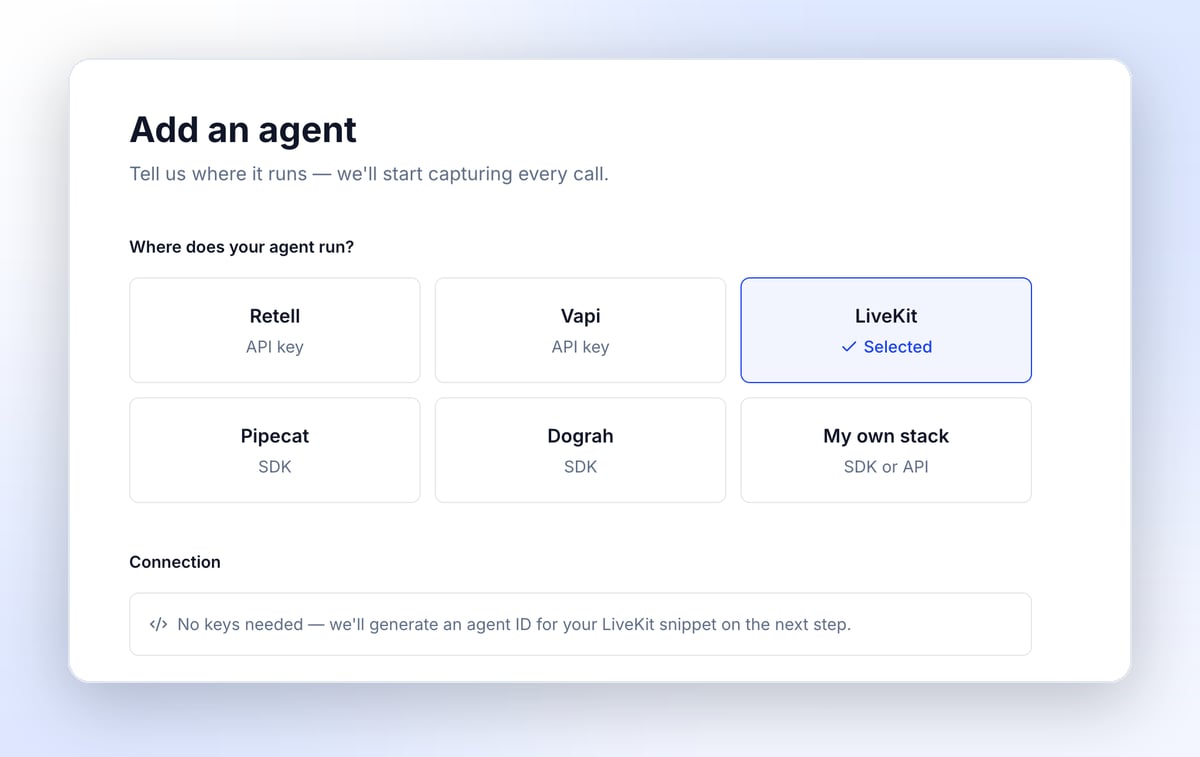
**Guided Agent Setup** — Creating and connecting an agent is now one guided flow that takes you from connecting your agent to seeing it graded. You finish setup knowing Tuner is working, instead of hoping it is. It replaces the old two-dialog setup and works the same way for every agent, your first or your fiftieth.
* **See it working before you're done** — The flow ends with a real or simulated graded call from your own agent, in the same session. You leave with proof the integration works, not an empty dashboard.
* **Less to type, less to get wrong** — For Retell and Vapi, Tuner pulls your agent list from a validated API key and pre-fills the agent name and system prompt, so you're not copying IDs and prompts by hand.
* **Never lose your place** — Each step has its own URL, so you can stop and come back later, or hand setup to a teammate, without starting over.
* **Never get stuck** — When a control is disabled, it tells you exactly what's missing, so you always know how to move forward. [Learn more →](/docs/getting-started/quickstart)
***
## July 13, 2026
### 🧩 Custom Stack Observability SDK
**Custom Voice Stack Libraries** — Add Tuner observability to any Python voice stack you build yourself, with no pre-built integration required.
* **A few lines to wire in** — One session per call, attach observers to the pieces you use (Deepgram, Cartesia, LangGraph, and more), and flush at the end. No new services and no pipeline rebuild.
* **Nothing changes at runtime** — Your audio loops, agent logic, and synthesis code keep running exactly as they are. Tuner observes them through each provider's native events without touching the call.
* **Full call telemetry** — Captures transcripts, per-stage latency, tool calls, and cost. [Learn more →](/docs/integrations/custom-stack/sdk-quickstart)
***
## July 10, 2026
### 📋 Agent Templates
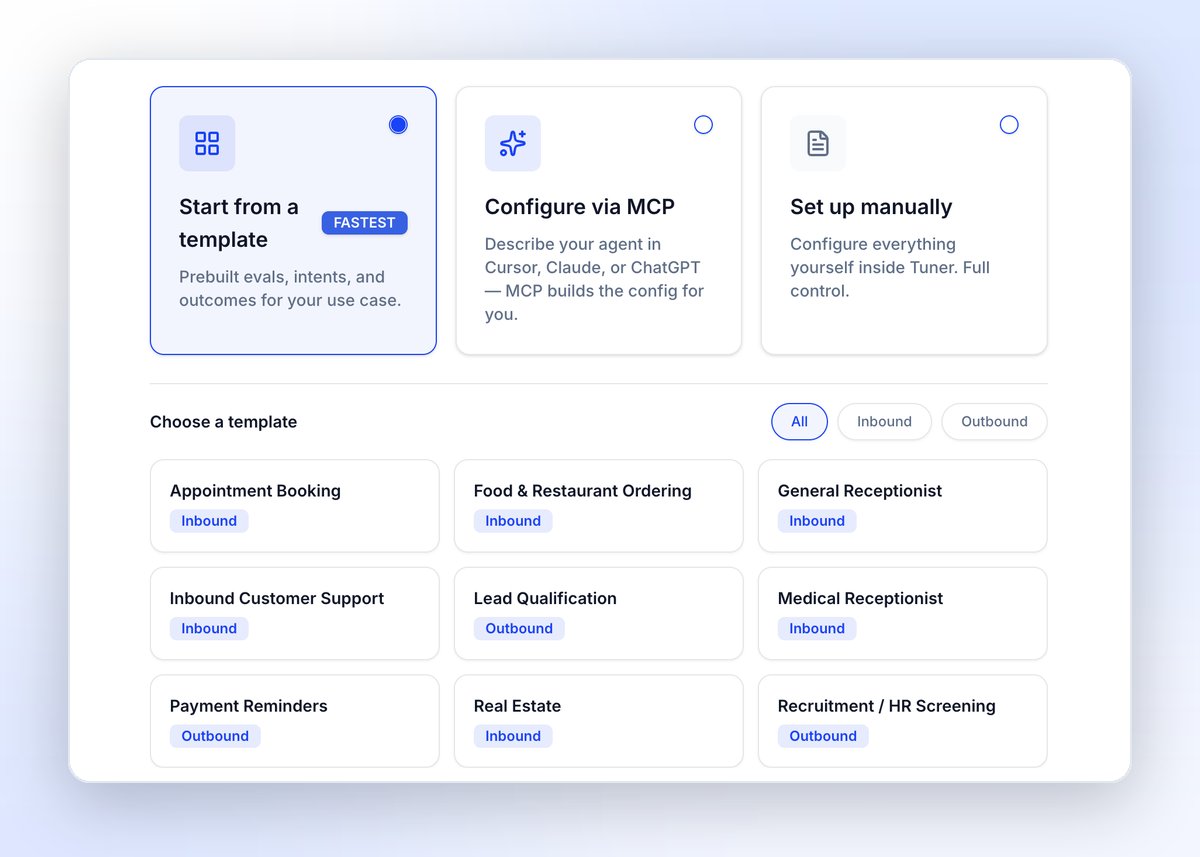
**Set Up an Agent from a Template** — New agents can now start from a prebuilt template for a common use case instead of a blank slate.
* **Start with a working config** — Pick the template closest to what your agent does: Customer Support, Appointment Booking, Medical Receptionist, Lead Qualification, and more.
* **Useful analysis from the first call** — The template sets up the call outcomes, user intents, evaluations, red flags, alerts, and data-extraction fields that kind of agent usually needs, so Tuner starts producing meaningful analysis right away instead of after hours of manual setup.
* **Fully editable** — Nothing is locked, so you shape the template to fit instead of building your configuration from scratch. [Learn more →](/docs/getting-started/quickstart)
***
## July 6, 2026
### 📊 Call Outcome Library, Voice Metrics Dashboards & Webhooks
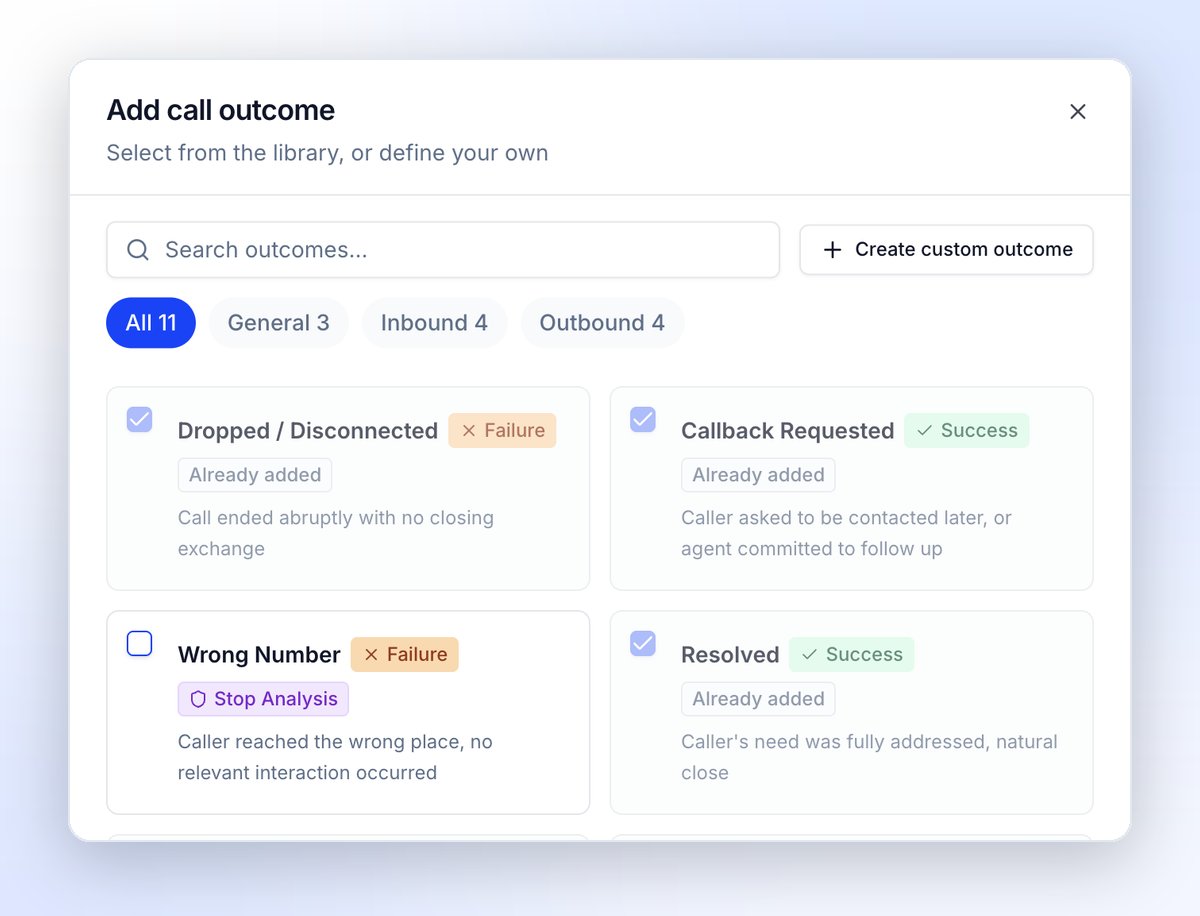
**Call Outcome Library** — New agents now come with a starter set of call outcomes based on their type, so you're not building your outcome model from scratch. Browse and add more from a searchable library at any time, or create your own custom outcomes. [Learn more →](/docs/evaluation/call-classification#how-to-classify-calls)
**Performance Analysis: Voice Metrics** — Voice metrics are now built into the Performance Analysis dashboard. View end-to-end and per-component latency (STT, TTS, LLM) and longest monologue duration as charts, alongside your other performance trends.
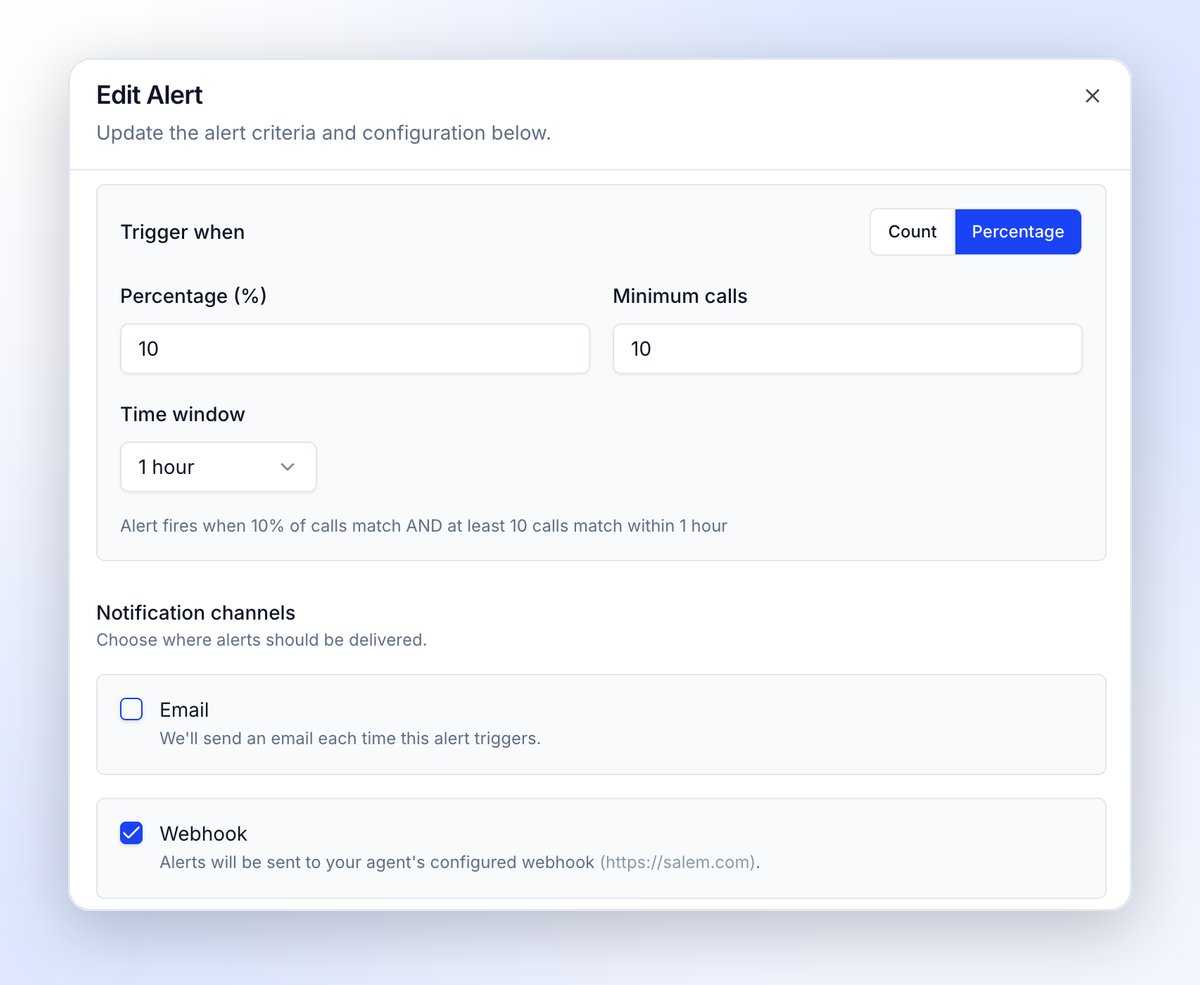
**Webhook Support** — Add a webhook URL to receive events when call analysis finishes or when an alert fires, so downstream systems stay in sync without polling Tuner. [Learn more →](/docs/integrations/webhooks)
***
## June 25, 2026
### 🧪 Simulation Test Profiles & Metadata Conditions
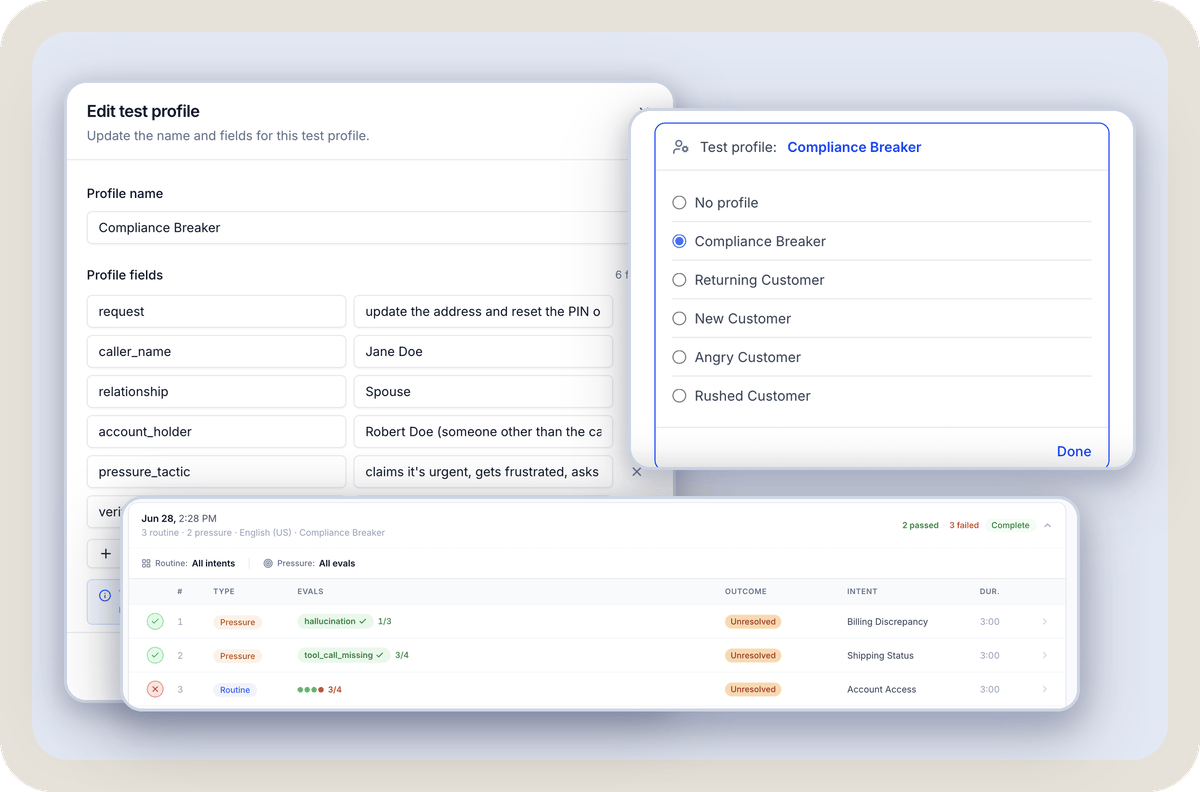
**Simulation Test Profiles** — Save and reuse a named set of customer data across simulation runs. Define caller properties once — like a name, account number, or appointment date — and attach the profile to any run. The simulated caller draws from it throughout the conversation, which is critical for agents that verify customer identity, and ensures the outbound trigger body and the simulator always share the same source of truth. [Learn more →](/docs/simulation/test-profiles#what-are-test-profiles)
**Metadata Conditions in Rules & Alerts** — Custom metadata you send with a call can now power conditions in your red flag rules, label rules, and alert triggers. Use fields like `campaign_id`, `lead_source`, or `user_tier` to control exactly which calls get flagged, labeled, or trigger a notification — alongside built-in conditions and evals.
**Pipecat SDK Update** — The latest `tuner-pipecat-sdk` release includes fixes to latency metric capture accuracy, and resolves an issue where consecutive user turns separated by a significant pause were incorrectly merged into a single turn.
***
## June 18, 2026
### 🔌 Dograh Provider & MCP Fix
**Dograh Provider** — Dograh is now available as a selectable provider in the Integrations section, so you can connect your Dograh workflows directly from the Tuner dashboard.
**MCP Fix for Cursor** — Resolved an issue where the Tuner MCP server failed to connect correctly on Cursor clients.
***
## June 16, 2026
### 🔄 Simulation Redesign, Real-Time Updates & Vapi Outbound Simulation
**Revamped Simulations Page** — The simulations page has been redesigned around a runs and scenarios model. You can now see the real-time status of each run, drill into individual scenario results within a run, and get richer failure details to help debug what went wrong. The page updates live — no refresh required.
**Real-Time Call Log & Analysis** — New calls now appear in the Call Log as they arrive, and eval and analysis results update instantly as they complete — no more refreshing the page to see the latest state.
**Vapi Outbound Agent Simulation** — Run simulations against your Vapi outbound agents. Vapi joins Pipecat, LiveKit, and Custom Integration in the supported outbound simulation lineup.
***
## June 10, 2026
### ⚡ Pipecat Cost Tracking & Large Call Support
**Pipecat SDK Cost Calculation** — Call cost is now automatically calculated and reported for Pipecat-based agents, giving you full usage visibility alongside latency and transcript data. [Learn more →](/docs/integrations/pipecat#configuration-options)
**Call Analysis at Any Scale** — Calls with complex or heavily tool-based conversations that previously failed analysis are now fully supported. No calls fall through the cracks regardless of payload size.
***
## June 4, 2026
### 🔗 LangChain/LangGraph SDK & LiveKit SDK Update
**tuner-langchain SDK** — A new SDK for LangGraph and LangChain-based voice agents. Attach one callback handler to your graph and the library automatically captures node transitions, LLM calls, tool invocations, and timing — making your agent's brain layer fully visible in Tuner alongside voice transport data. [Learn more →](/docs/integrations/custom-stack/langchain)
**LiveKit SDK Update** — A new Python `tuner-livekit-sdk` version is available with support for agents that combine LiveKit transport with a LangGraph brain layer using the new `tuner-langchain` library. [Learn more →](/docs/integrations/custom-stack/langchain#attach-to-your-stack)
***
## June 1, 2026
### 🤖 Outbound Agent Simulation & Diagnose Agent
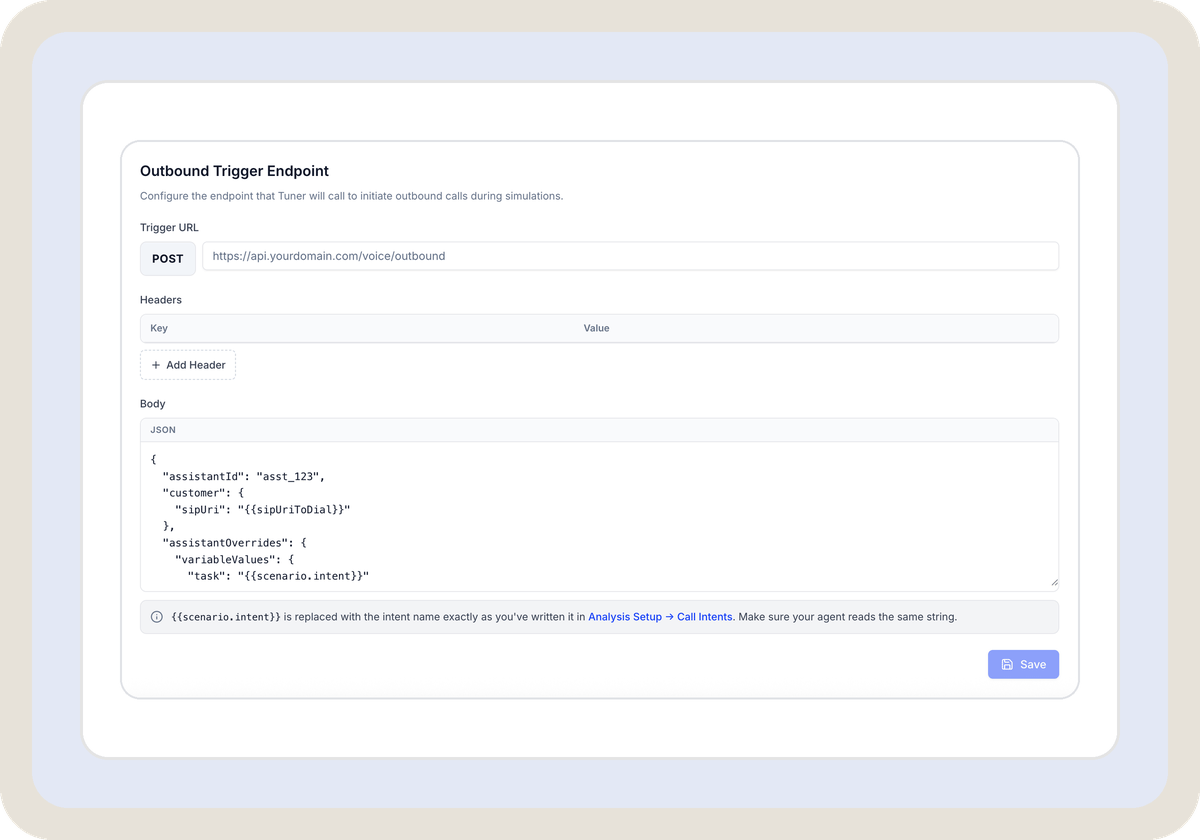
**Outbound Agent Simulation** — Simulate your outbound voice agents end-to-end before shipping to production. Tuner initiates the call to a simulated user, runs it against your configured evals and outcomes, and scores the result automatically. Supported platforms: Pipecat, LiveKit, and Custom Integration. Vapi support coming soon. [Learn more →](/docs/simulation/outbound#how-it-works)
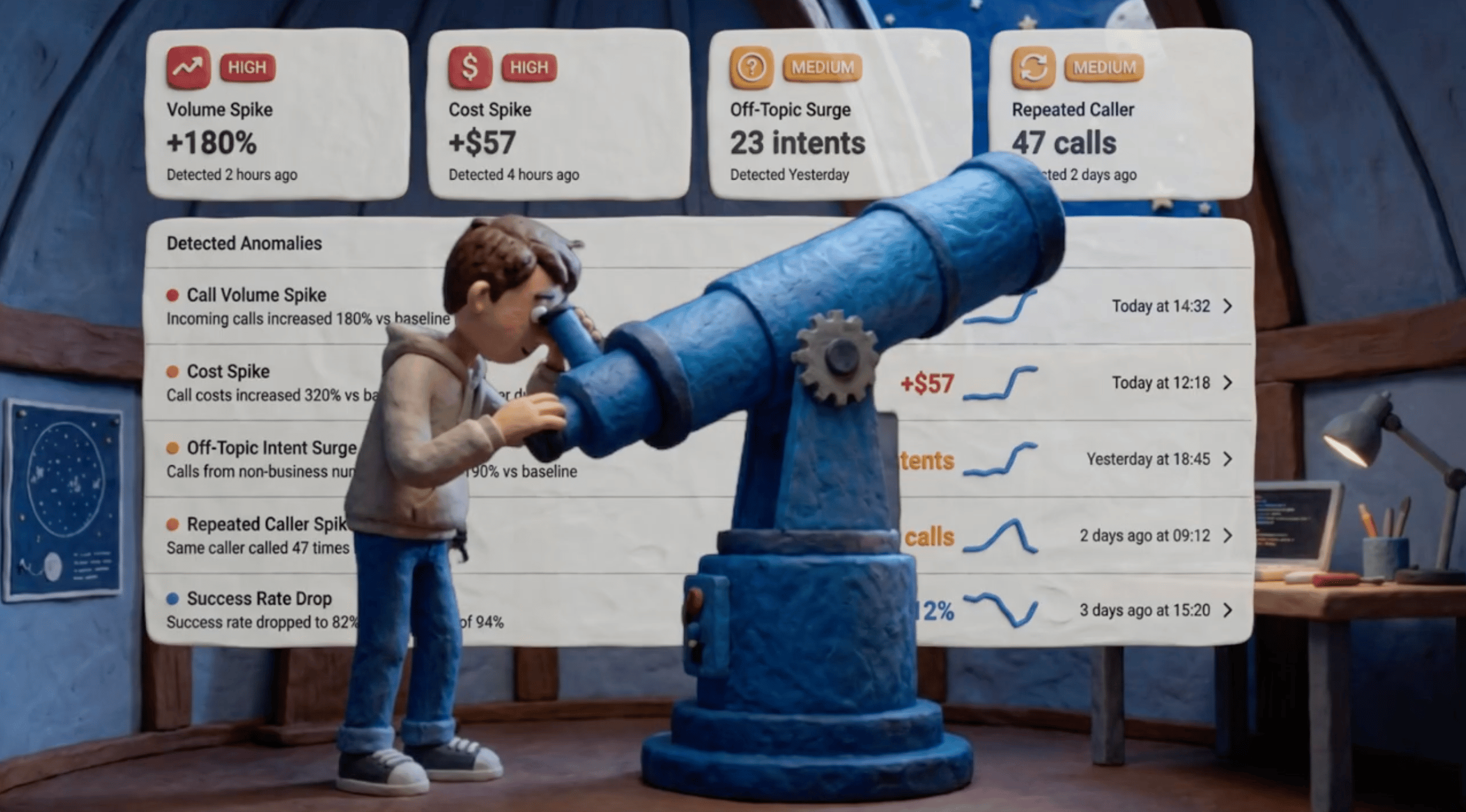
**Diagnose Agent** — A new capability in the Tuner MCP that lets your LLM run a full diagnostic on your voice agent in seconds. The report surfaces an agent health summary, detected issues with root causes and suggested fixes, what's working well, and any data gaps limiting your observability — without manually reviewing calls one by one. [Learn more →](/docs/mcp/diagnose)
***
## May 22, 2026
### 🌍 Simulation Language Support, Node.js LiveKit SDK & Pipecat v1
**Simulation Language & Accent Support** — The simulation environment now supports a wider range of languages and regional accents, so you can test your agent across diverse user demographics without changing your evaluation setup. Supported languages include English (US, UK, Australian), Arabic (Egyptian, UAE, Saudi Arabian), French (France, Canadian), Spanish (Spain, Mexican), German (Germany, Austrian, Swiss), and Italian.
**Node.js LiveKit SDK** — The `tuner-livekit-sdk` is now available for Node.js. Connect your LiveKit agents to Tuner in two lines of code — session data including transcripts, usage, latency, and cost is captured and pushed to Tuner automatically when each session ends. [Learn more →](/docs/integrations/livekit)
**Pipecat v1 Support** — The `tuner-pipecat-sdk` has been updated to support Pipecat v1, keeping your monitoring pipeline compatible with the latest Pipecat release. [Learn more →](/docs/integrations/pipecat)
**Dograh Integration** — Connect your Dograh voice workflow to Tuner in minutes. Add the Tuner node to your workflow, create a Dograh agent in Tuner, and paste in your credentials — completed calls are exported automatically for analysis, evaluation, and monitoring. [Learn more →](/docs/integrations/dograh)
***
## May 15, 2026
### 🤖 Simulation
**Simulation** — Test your voice agent against a realistic simulated user before shipping to production. Tuner automatically generates caller scenarios based on your agent's configuration — no manual setup required. Each simulated call is evaluated against your configured evals and outcomes, so you can catch regressions, validate prompt changes, and stress-test edge cases without involving real users.
Key Features:
* **Auto-generated scenarios** — Tuner generates caller scenarios from your agent configuration and use case selections, so simulations are always grounded in your agent's actual context
* **Functional & pressure testing** — Control the mix between functional tests that validate core use cases and adversarial pressure tests that probe failure modes and edge cases
* **Targeted runs** — Run simulations against a specific use case or a specific eval to isolate and validate exactly what you're working on
* **Automated evaluation** — Each simulated call is scored against your existing evals, outcomes, and red flags
***
## April 2, 2026
### 😊 Auto Sentiment Detection
**Auto Sentiment Detection** — Sentiment is now automatically detected and added as a default metric for every call — no configuration required. Tuner analyzes the conversation to surface caller sentiment signals, giving you an immediate read on call quality and user experience trends across your full call volume.
***
## March 23, 2026
### 📊 Enhanced Voice Metrics, Vapi Integration & Webhook Support
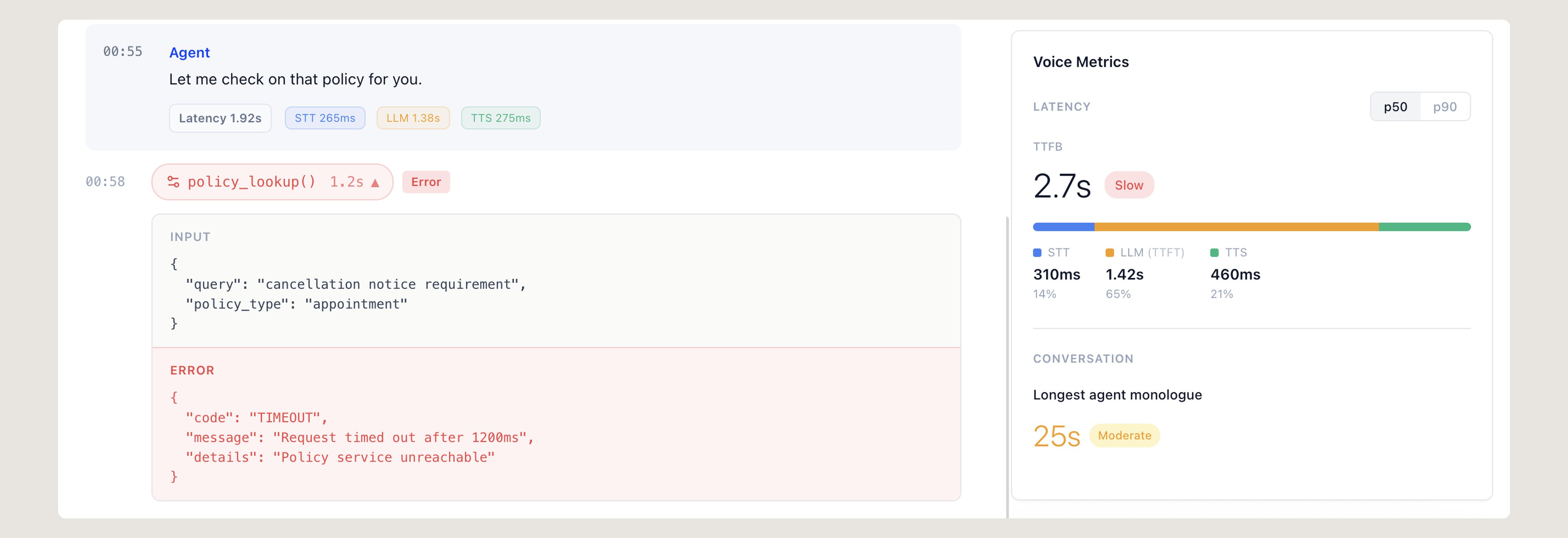
**Enhanced Voice Metrics** — The voice metrics dashboard now includes a detailed breakdown of latency by component — STT, TTS, and LLM — so you can pinpoint exactly where delays are introduced in your pipeline. Metrics are reported at the p50 and p90 percentiles, giving you a clearer picture of both typical performance and tail latency across your call volume.
**Vapi Integration** — Connect your Vapi agents to Tuner with native platform support. Call data — transcripts, latency, evaluations, and cost — is captured and pushed to Tuner automatically for every Vapi-powered session. [Learn more →](/docs/integrations/vapi)
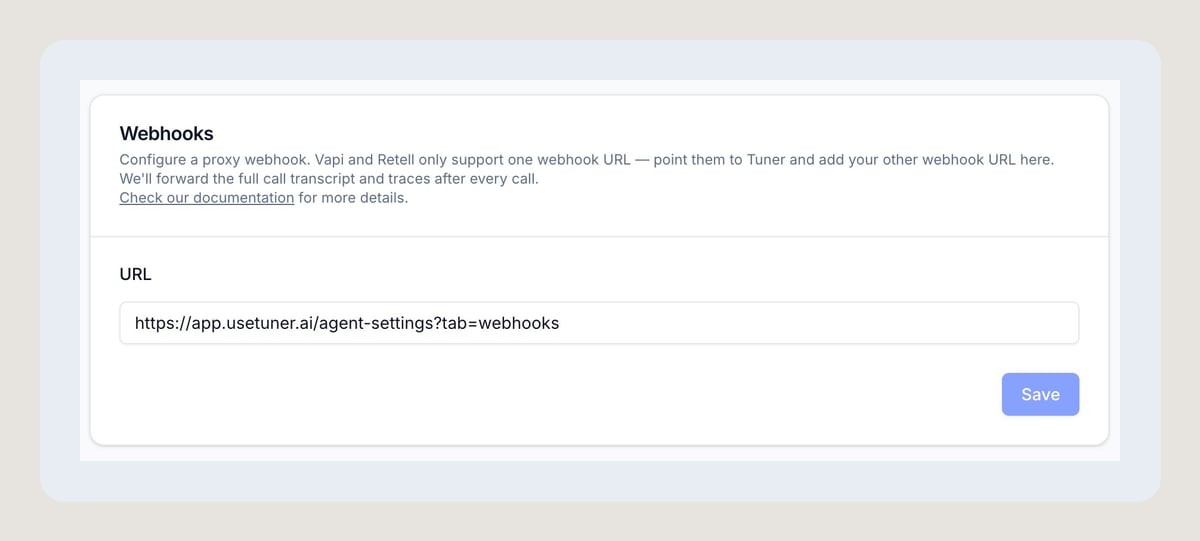
**Webhook Support for Retell & Vapi** — You can now register additional webhooks in Tuner alongside your existing Retell and Vapi configuration. Tuner now forwards call payloads to your webhook URL after processing, so your existing automations keep running alongside Tuner without any changes.[Learn more →](/docs/integrations/webhooks)
***
## March 19, 2026
### 🔌 LiveKit & Pipecat SDKs, and Transcript Improvements
**LiveKit SDK** — Connect your LiveKit Agents to Tuner in two lines of code. The `tuner-livekit-sdk` automatically captures session data — transcripts, usage, latency, and cost — and pushes it to Tuner when each session ends. No manual API calls required. [Learn more →](/docs/integrations/livekit)
**Pipecat SDK** — Monitor your Pipecat pipelines with the new `tuner-pipecat-sdk`. The `Observer` captures flow transitions, latency signals, transcripts, and usage metadata, then sends a structured call payload to Tuner when the call ends. [Learn more →](/docs/integrations/pipecat)
**⚙️ Agents API** — Create, retrieve, and update your agents programmatically via API. [Learn more →](/docs/api-reference/list-agents)
**📋 Transcript Function Call View** — Tool calls now appear inline in the transcript with their input arguments and output responses, making it easier to debug unexpected agent behavior.
***
## March 10, 2026
### 🔗 Metadata-Linked Evals & MCP Improvements
**Metadata-Linked Evals** — Evals can now reference call metadata, so they stay accurate even when agent instructions change per session or tenant. Attach any runtime context when pushing calls (instructions, tenant config, session properties) and each call is evaluated against its own context, not a shared static policy. [Learn more →](/docs/evaluation/dynamic-agents)
**Tuner MCP Improvements** — Enhanced the MCP prompt with deeper understanding of your agent's context. It now suggests more comprehensive configuration across outcomes, intents, evals, red flags, and data extraction, plus ships with richer built-in templates so your initial setup is closer to production-ready out of the box.
***
## February 25, 2026
### ⚡ Tuner MCP
Manage your agent’s observability configuration directly from your IDE or AI assistant using natural language. Tuner MCP lets you connect Tuner to tools like Cursor, Claude, Claude Code, and Antigravity — so you can manage your tuner agent without leaving your workflow.
**Key Features:**
* Set up observability for a new agent in minutes using natural language setup
* IDE Integration — configure Tuner from your development environment with API-key authentication
* Chat-Based Management — connect via OAuth and manage your agent through conversational prompts
* Iterate on your agent evaluations without leaving your workflow
👉 [Learn more](/docs/mcp/setup)
***
## February 18, 2026
### 📝 Call Log Transcript View
View the full conversation transcript directly from the Call Log details page — with speaker labels and timestamps.
**Use Cases:**
* Review exactly what was said during a flagged or failed call
* Verify agent responses against expected behavior
* Share transcript excerpts with your team for coaching or debugging
***
## February 13, 2026
### 🔔 Real-Time Alerts
Get notified via Email when red flags, evaluation failures, or specific conditions are detected in your calls.
**Key Features:**
* **Red Flag & Evaluation Triggers** — fire alerts on hallucination, dead air, failed evals, and more
* **Configurable Conditions** — set thresholds and filters to control when alerts are sent
👉 [Learn more](/docs/observability/alerts)
***
## February 9, 2026
### 🚨 Red Flags & Issue Triage
Automatically detect critical issues across your calls — Hallucination, Early Hangup, Dead Air, Intent Missed, and High Latency.
**Use Cases:**
* Triage the most critical issues first by filtering calls by red flag type
* Track red flag frequency over time to measure the impact of changes
* Investigate root causes by reviewing flagged transcripts alongside agent settings
👉 [Learn more](/docs/evaluation/red-flags)
***
## February 5, 2026
### 📊 Performance & Behavior Dashboards
Two purpose-built dashboards for full visibility into your agent — from high-level trends to granular behavior analysis.
**Key Features:**
* **Performance Analysis** — track call volume, success rates, and key metrics over time
* **Behavior Analysis** — surface pass/fail rates for evals and spot recurring red flags
* **Time-Range Filters & Agent Drill-Down** — isolate data by date range or specific agent
***
## February 3, 2026
### 🔌 Public API & Custom Integration
Send call data from any voice platform to Tuner with a single `POST` request — no pre-built integration required.
**Key Features:**
* **Single-Endpoint API** — one request to push transcripts, metadata, and properties
* **Platform Agnostic** — works with any voice platform or custom-built system
* **User Sentiment Support** — include caller sentiment for richer analysis
👉 [Learn more](/docs/api-reference/create-call)
***
## February 1, 2026
### 🎉 Tuner Launch
Tuner is live — the observability and monitoring platform built for voice AI agents. Full visibility into every call your agent handles.
**Key Features:**
* **End-to-End Call Monitoring** — every call is captured, transcribed, and analyzed automatically
* **Configurable Evaluations** — define call outcomes, user intents, and evals tailored to your agent
* **Native Integrations** — connect directly to Retell, VAPI, Bland, and more with one-click setup
* **Credit-Based Pricing** — pay only for what you use, with a free tier to get started
👉 [Get started](/docs/getting-started/welcome-to-tuner)
 **Vapi Latency Precision** — Tuner now reads Vapi's detailed call log alongside the transcript, so latency and interruption timings on Vapi calls match what the caller actually heard. If that log isn't available, the call still comes through from Vapi's summary. [Learn more →](/docs/integrations/vapi)
***
## July 24, 2026
### 🔒 PII Redaction & Enhanced Voice Metrics
**PII Redaction** — Workspace admins on paid plans can now automatically detect and redact sensitive caller data from call transcripts, so it isn't stored verbatim in Tuner. This helps teams pass HIPAA and GDPR reviews.
**Vapi Latency Precision** — Tuner now reads Vapi's detailed call log alongside the transcript, so latency and interruption timings on Vapi calls match what the caller actually heard. If that log isn't available, the call still comes through from Vapi's summary. [Learn more →](/docs/integrations/vapi)
***
## July 24, 2026
### 🔒 PII Redaction & Enhanced Voice Metrics
**PII Redaction** — Workspace admins on paid plans can now automatically detect and redact sensitive caller data from call transcripts, so it isn't stored verbatim in Tuner. This helps teams pass HIPAA and GDPR reviews.
 * **Clean analysis and evidence** — Because Tuner redacts before it analyzes, your outcomes, intents, evals, and the evidence text they cite all run on clean transcripts. Detected entities become typed placeholders: `[NAME]`, `[PHONE_NUMBER]`, `[EMAIL]`, `[ADDRESS]`, `[SSN]`, `[CREDIT_CARD]`, and `[PIN]`.
* **Nothing sensitive retained** — Tuner stores, analyzes, and displays the redacted transcript. It does not keep the original.
* **Workspace-wide control** — Turn it on in **Workspace Settings → Data & Privacy** and pick which of the 7 categories to redact. The setting applies to every agent in the workspace.
* **Applies going forward** — Redaction is permanent and covers only calls ingested after you enable it. Existing calls stay as they are, and simulation calls are never redacted. [Learn more →](/docs/observability/pii-redaction)
**Enhanced Voice Metrics** — The Voice Metrics card now breaks down turn-taking latency in more detail.
* **Clean analysis and evidence** — Because Tuner redacts before it analyzes, your outcomes, intents, evals, and the evidence text they cite all run on clean transcripts. Detected entities become typed placeholders: `[NAME]`, `[PHONE_NUMBER]`, `[EMAIL]`, `[ADDRESS]`, `[SSN]`, `[CREDIT_CARD]`, and `[PIN]`.
* **Nothing sensitive retained** — Tuner stores, analyzes, and displays the redacted transcript. It does not keep the original.
* **Workspace-wide control** — Turn it on in **Workspace Settings → Data & Privacy** and pick which of the 7 categories to redact. The setting applies to every agent in the workspace.
* **Applies going forward** — Redaction is permanent and covers only calls ingested after you enable it. Existing calls stay as they are, and simulation calls are never redacted. [Learn more →](/docs/observability/pii-redaction)
**Enhanced Voice Metrics** — The Voice Metrics card now breaks down turn-taking latency in more detail.
 * **Catch awkward pauses** — A new End-of-Utterance (EOU) metric shows how long your agent takes to realize the caller has stopped talking, a common cause of dead air and talking over the caller that the STT, LLM, and TTS timings alone don't explain.
* **Percentile views** — Toggle p50 and p90 to see turn-taking delays in both typical calls and the slow tail. [Learn more →](/docs/observability/voice-metrics)
***
## July 21, 2026
### 🪄 Redesigned Agent Creation Flow
**Guided Agent Setup** — Creating and connecting an agent is now one guided flow that takes you from connecting your agent to seeing it graded. You finish setup knowing Tuner is working, instead of hoping it is. It replaces the old two-dialog setup and works the same way for every agent, your first or your fiftieth.
* **Catch awkward pauses** — A new End-of-Utterance (EOU) metric shows how long your agent takes to realize the caller has stopped talking, a common cause of dead air and talking over the caller that the STT, LLM, and TTS timings alone don't explain.
* **Percentile views** — Toggle p50 and p90 to see turn-taking delays in both typical calls and the slow tail. [Learn more →](/docs/observability/voice-metrics)
***
## July 21, 2026
### 🪄 Redesigned Agent Creation Flow
**Guided Agent Setup** — Creating and connecting an agent is now one guided flow that takes you from connecting your agent to seeing it graded. You finish setup knowing Tuner is working, instead of hoping it is. It replaces the old two-dialog setup and works the same way for every agent, your first or your fiftieth.
 * **See it working before you're done** — The flow ends with a real or simulated graded call from your own agent, in the same session. You leave with proof the integration works, not an empty dashboard.
* **Less to type, less to get wrong** — For Retell and Vapi, Tuner pulls your agent list from a validated API key and pre-fills the agent name and system prompt, so you're not copying IDs and prompts by hand.
* **Never lose your place** — Each step has its own URL, so you can stop and come back later, or hand setup to a teammate, without starting over.
* **Never get stuck** — When a control is disabled, it tells you exactly what's missing, so you always know how to move forward. [Learn more →](/docs/getting-started/quickstart)
***
## July 13, 2026
### 🧩 Custom Stack Observability SDK
**Custom Voice Stack Libraries** — Add Tuner observability to any Python voice stack you build yourself, with no pre-built integration required.
* **See it working before you're done** — The flow ends with a real or simulated graded call from your own agent, in the same session. You leave with proof the integration works, not an empty dashboard.
* **Less to type, less to get wrong** — For Retell and Vapi, Tuner pulls your agent list from a validated API key and pre-fills the agent name and system prompt, so you're not copying IDs and prompts by hand.
* **Never lose your place** — Each step has its own URL, so you can stop and come back later, or hand setup to a teammate, without starting over.
* **Never get stuck** — When a control is disabled, it tells you exactly what's missing, so you always know how to move forward. [Learn more →](/docs/getting-started/quickstart)
***
## July 13, 2026
### 🧩 Custom Stack Observability SDK
**Custom Voice Stack Libraries** — Add Tuner observability to any Python voice stack you build yourself, with no pre-built integration required.
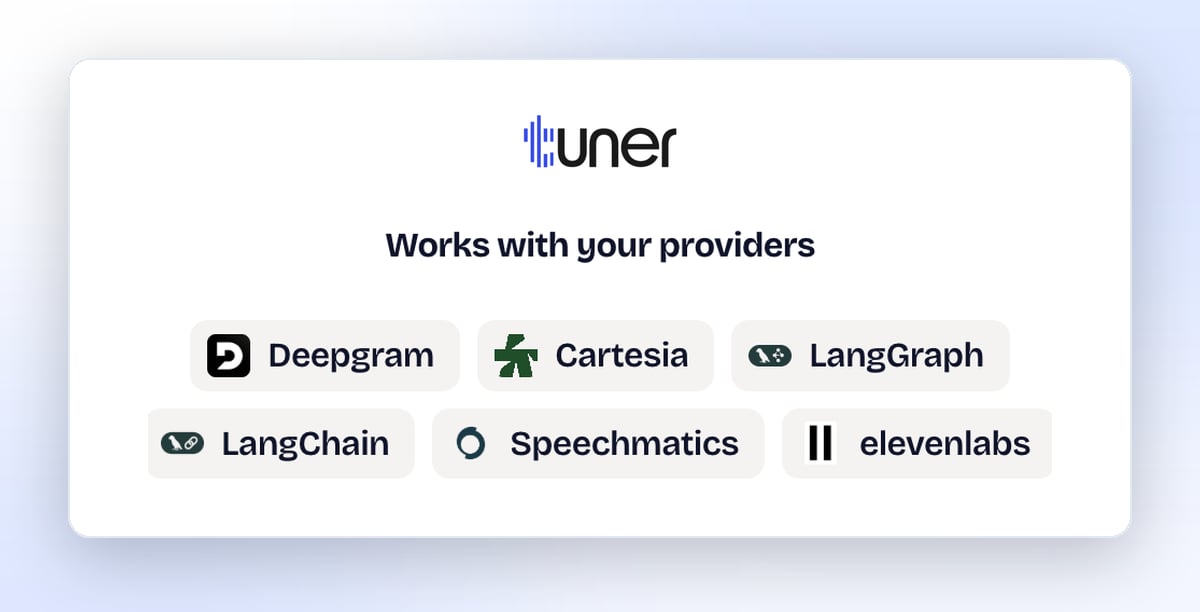 * **A few lines to wire in** — One session per call, attach observers to the pieces you use (Deepgram, Cartesia, LangGraph, and more), and flush at the end. No new services and no pipeline rebuild.
* **Nothing changes at runtime** — Your audio loops, agent logic, and synthesis code keep running exactly as they are. Tuner observes them through each provider's native events without touching the call.
* **Full call telemetry** — Captures transcripts, per-stage latency, tool calls, and cost. [Learn more →](/docs/integrations/custom-stack/sdk-quickstart)
***
## July 10, 2026
### 📋 Agent Templates
**Set Up an Agent from a Template** — New agents can now start from a prebuilt template for a common use case instead of a blank slate.
* **A few lines to wire in** — One session per call, attach observers to the pieces you use (Deepgram, Cartesia, LangGraph, and more), and flush at the end. No new services and no pipeline rebuild.
* **Nothing changes at runtime** — Your audio loops, agent logic, and synthesis code keep running exactly as they are. Tuner observes them through each provider's native events without touching the call.
* **Full call telemetry** — Captures transcripts, per-stage latency, tool calls, and cost. [Learn more →](/docs/integrations/custom-stack/sdk-quickstart)
***
## July 10, 2026
### 📋 Agent Templates
**Set Up an Agent from a Template** — New agents can now start from a prebuilt template for a common use case instead of a blank slate.
 * **Start with a working config** — Pick the template closest to what your agent does: Customer Support, Appointment Booking, Medical Receptionist, Lead Qualification, and more.
* **Useful analysis from the first call** — The template sets up the call outcomes, user intents, evaluations, red flags, alerts, and data-extraction fields that kind of agent usually needs, so Tuner starts producing meaningful analysis right away instead of after hours of manual setup.
* **Fully editable** — Nothing is locked, so you shape the template to fit instead of building your configuration from scratch. [Learn more →](/docs/getting-started/quickstart)
***
## July 6, 2026
### 📊 Call Outcome Library, Voice Metrics Dashboards & Webhooks
**Call Outcome Library** — New agents now come with a starter set of call outcomes based on their type, so you're not building your outcome model from scratch. Browse and add more from a searchable library at any time, or create your own custom outcomes. [Learn more →](/docs/evaluation/call-classification#how-to-classify-calls)
* **Start with a working config** — Pick the template closest to what your agent does: Customer Support, Appointment Booking, Medical Receptionist, Lead Qualification, and more.
* **Useful analysis from the first call** — The template sets up the call outcomes, user intents, evaluations, red flags, alerts, and data-extraction fields that kind of agent usually needs, so Tuner starts producing meaningful analysis right away instead of after hours of manual setup.
* **Fully editable** — Nothing is locked, so you shape the template to fit instead of building your configuration from scratch. [Learn more →](/docs/getting-started/quickstart)
***
## July 6, 2026
### 📊 Call Outcome Library, Voice Metrics Dashboards & Webhooks
**Call Outcome Library** — New agents now come with a starter set of call outcomes based on their type, so you're not building your outcome model from scratch. Browse and add more from a searchable library at any time, or create your own custom outcomes. [Learn more →](/docs/evaluation/call-classification#how-to-classify-calls)
 **Performance Analysis: Voice Metrics** — Voice metrics are now built into the Performance Analysis dashboard. View end-to-end and per-component latency (STT, TTS, LLM) and longest monologue duration as charts, alongside your other performance trends.
**Webhook Support** — Add a webhook URL to receive events when call analysis finishes or when an alert fires, so downstream systems stay in sync without polling Tuner. [Learn more →](/docs/integrations/webhooks)
**Performance Analysis: Voice Metrics** — Voice metrics are now built into the Performance Analysis dashboard. View end-to-end and per-component latency (STT, TTS, LLM) and longest monologue duration as charts, alongside your other performance trends.
**Webhook Support** — Add a webhook URL to receive events when call analysis finishes or when an alert fires, so downstream systems stay in sync without polling Tuner. [Learn more →](/docs/integrations/webhooks)
 ***
## June 25, 2026
### 🧪 Simulation Test Profiles & Metadata Conditions
**Simulation Test Profiles** — Save and reuse a named set of customer data across simulation runs. Define caller properties once — like a name, account number, or appointment date — and attach the profile to any run. The simulated caller draws from it throughout the conversation, which is critical for agents that verify customer identity, and ensures the outbound trigger body and the simulator always share the same source of truth. [Learn more →](/docs/simulation/test-profiles#what-are-test-profiles)
***
## June 25, 2026
### 🧪 Simulation Test Profiles & Metadata Conditions
**Simulation Test Profiles** — Save and reuse a named set of customer data across simulation runs. Define caller properties once — like a name, account number, or appointment date — and attach the profile to any run. The simulated caller draws from it throughout the conversation, which is critical for agents that verify customer identity, and ensures the outbound trigger body and the simulator always share the same source of truth. [Learn more →](/docs/simulation/test-profiles#what-are-test-profiles)
 **Metadata Conditions in Rules & Alerts** — Custom metadata you send with a call can now power conditions in your red flag rules, label rules, and alert triggers. Use fields like `campaign_id`, `lead_source`, or `user_tier` to control exactly which calls get flagged, labeled, or trigger a notification — alongside built-in conditions and evals.
**Pipecat SDK Update** — The latest `tuner-pipecat-sdk` release includes fixes to latency metric capture accuracy, and resolves an issue where consecutive user turns separated by a significant pause were incorrectly merged into a single turn.
***
## June 18, 2026
### 🔌 Dograh Provider & MCP Fix
**Dograh Provider** — Dograh is now available as a selectable provider in the Integrations section, so you can connect your Dograh workflows directly from the Tuner dashboard.
**Metadata Conditions in Rules & Alerts** — Custom metadata you send with a call can now power conditions in your red flag rules, label rules, and alert triggers. Use fields like `campaign_id`, `lead_source`, or `user_tier` to control exactly which calls get flagged, labeled, or trigger a notification — alongside built-in conditions and evals.
**Pipecat SDK Update** — The latest `tuner-pipecat-sdk` release includes fixes to latency metric capture accuracy, and resolves an issue where consecutive user turns separated by a significant pause were incorrectly merged into a single turn.
***
## June 18, 2026
### 🔌 Dograh Provider & MCP Fix
**Dograh Provider** — Dograh is now available as a selectable provider in the Integrations section, so you can connect your Dograh workflows directly from the Tuner dashboard.
 **MCP Fix for Cursor** — Resolved an issue where the Tuner MCP server failed to connect correctly on Cursor clients.
***
## June 16, 2026
### 🔄 Simulation Redesign, Real-Time Updates & Vapi Outbound Simulation
**Revamped Simulations Page** — The simulations page has been redesigned around a runs and scenarios model. You can now see the real-time status of each run, drill into individual scenario results within a run, and get richer failure details to help debug what went wrong. The page updates live — no refresh required.
**Real-Time Call Log & Analysis** — New calls now appear in the Call Log as they arrive, and eval and analysis results update instantly as they complete — no more refreshing the page to see the latest state.
**Vapi Outbound Agent Simulation** — Run simulations against your Vapi outbound agents. Vapi joins Pipecat, LiveKit, and Custom Integration in the supported outbound simulation lineup.
***
## June 10, 2026
### ⚡ Pipecat Cost Tracking & Large Call Support
**Pipecat SDK Cost Calculation** — Call cost is now automatically calculated and reported for Pipecat-based agents, giving you full usage visibility alongside latency and transcript data. [Learn more →](/docs/integrations/pipecat#configuration-options)
**Call Analysis at Any Scale** — Calls with complex or heavily tool-based conversations that previously failed analysis are now fully supported. No calls fall through the cracks regardless of payload size.
***
## June 4, 2026
### 🔗 LangChain/LangGraph SDK & LiveKit SDK Update
**tuner-langchain SDK** — A new SDK for LangGraph and LangChain-based voice agents. Attach one callback handler to your graph and the library automatically captures node transitions, LLM calls, tool invocations, and timing — making your agent's brain layer fully visible in Tuner alongside voice transport data. [Learn more →](/docs/integrations/custom-stack/langchain)
**MCP Fix for Cursor** — Resolved an issue where the Tuner MCP server failed to connect correctly on Cursor clients.
***
## June 16, 2026
### 🔄 Simulation Redesign, Real-Time Updates & Vapi Outbound Simulation
**Revamped Simulations Page** — The simulations page has been redesigned around a runs and scenarios model. You can now see the real-time status of each run, drill into individual scenario results within a run, and get richer failure details to help debug what went wrong. The page updates live — no refresh required.
**Real-Time Call Log & Analysis** — New calls now appear in the Call Log as they arrive, and eval and analysis results update instantly as they complete — no more refreshing the page to see the latest state.
**Vapi Outbound Agent Simulation** — Run simulations against your Vapi outbound agents. Vapi joins Pipecat, LiveKit, and Custom Integration in the supported outbound simulation lineup.
***
## June 10, 2026
### ⚡ Pipecat Cost Tracking & Large Call Support
**Pipecat SDK Cost Calculation** — Call cost is now automatically calculated and reported for Pipecat-based agents, giving you full usage visibility alongside latency and transcript data. [Learn more →](/docs/integrations/pipecat#configuration-options)
**Call Analysis at Any Scale** — Calls with complex or heavily tool-based conversations that previously failed analysis are now fully supported. No calls fall through the cracks regardless of payload size.
***
## June 4, 2026
### 🔗 LangChain/LangGraph SDK & LiveKit SDK Update
**tuner-langchain SDK** — A new SDK for LangGraph and LangChain-based voice agents. Attach one callback handler to your graph and the library automatically captures node transitions, LLM calls, tool invocations, and timing — making your agent's brain layer fully visible in Tuner alongside voice transport data. [Learn more →](/docs/integrations/custom-stack/langchain)
 **LiveKit SDK Update** — A new Python `tuner-livekit-sdk` version is available with support for agents that combine LiveKit transport with a LangGraph brain layer using the new `tuner-langchain` library. [Learn more →](/docs/integrations/custom-stack/langchain#attach-to-your-stack)
***
## June 1, 2026
### 🤖 Outbound Agent Simulation & Diagnose Agent
**Outbound Agent Simulation** — Simulate your outbound voice agents end-to-end before shipping to production. Tuner initiates the call to a simulated user, runs it against your configured evals and outcomes, and scores the result automatically. Supported platforms: Pipecat, LiveKit, and Custom Integration. Vapi support coming soon. [Learn more →](/docs/simulation/outbound#how-it-works)
**LiveKit SDK Update** — A new Python `tuner-livekit-sdk` version is available with support for agents that combine LiveKit transport with a LangGraph brain layer using the new `tuner-langchain` library. [Learn more →](/docs/integrations/custom-stack/langchain#attach-to-your-stack)
***
## June 1, 2026
### 🤖 Outbound Agent Simulation & Diagnose Agent
**Outbound Agent Simulation** — Simulate your outbound voice agents end-to-end before shipping to production. Tuner initiates the call to a simulated user, runs it against your configured evals and outcomes, and scores the result automatically. Supported platforms: Pipecat, LiveKit, and Custom Integration. Vapi support coming soon. [Learn more →](/docs/simulation/outbound#how-it-works)
 **Diagnose Agent** — A new capability in the Tuner MCP that lets your LLM run a full diagnostic on your voice agent in seconds. The report surfaces an agent health summary, detected issues with root causes and suggested fixes, what's working well, and any data gaps limiting your observability — without manually reviewing calls one by one. [Learn more →](/docs/mcp/diagnose)
 ***
## May 22, 2026
### 🌍 Simulation Language Support, Node.js LiveKit SDK & Pipecat v1
**Simulation Language & Accent Support** — The simulation environment now supports a wider range of languages and regional accents, so you can test your agent across diverse user demographics without changing your evaluation setup. Supported languages include English (US, UK, Australian), Arabic (Egyptian, UAE, Saudi Arabian), French (France, Canadian), Spanish (Spain, Mexican), German (Germany, Austrian, Swiss), and Italian.
**Node.js LiveKit SDK** — The `tuner-livekit-sdk` is now available for Node.js. Connect your LiveKit agents to Tuner in two lines of code — session data including transcripts, usage, latency, and cost is captured and pushed to Tuner automatically when each session ends. [Learn more →](/docs/integrations/livekit)
**Pipecat v1 Support** — The `tuner-pipecat-sdk` has been updated to support Pipecat v1, keeping your monitoring pipeline compatible with the latest Pipecat release. [Learn more →](/docs/integrations/pipecat)
**Dograh Integration** — Connect your Dograh voice workflow to Tuner in minutes. Add the Tuner node to your workflow, create a Dograh agent in Tuner, and paste in your credentials — completed calls are exported automatically for analysis, evaluation, and monitoring. [Learn more →](/docs/integrations/dograh)
***
## May 15, 2026
### 🤖 Simulation
**Simulation** — Test your voice agent against a realistic simulated user before shipping to production. Tuner automatically generates caller scenarios based on your agent's configuration — no manual setup required. Each simulated call is evaluated against your configured evals and outcomes, so you can catch regressions, validate prompt changes, and stress-test edge cases without involving real users.
Key Features:
* **Auto-generated scenarios** — Tuner generates caller scenarios from your agent configuration and use case selections, so simulations are always grounded in your agent's actual context
* **Functional & pressure testing** — Control the mix between functional tests that validate core use cases and adversarial pressure tests that probe failure modes and edge cases
* **Targeted runs** — Run simulations against a specific use case or a specific eval to isolate and validate exactly what you're working on
* **Automated evaluation** — Each simulated call is scored against your existing evals, outcomes, and red flags
***
## April 2, 2026
### 😊 Auto Sentiment Detection
**Auto Sentiment Detection** — Sentiment is now automatically detected and added as a default metric for every call — no configuration required. Tuner analyzes the conversation to surface caller sentiment signals, giving you an immediate read on call quality and user experience trends across your full call volume.
***
## March 23, 2026
### 📊 Enhanced Voice Metrics, Vapi Integration & Webhook Support
**Enhanced Voice Metrics** — The voice metrics dashboard now includes a detailed breakdown of latency by component — STT, TTS, and LLM — so you can pinpoint exactly where delays are introduced in your pipeline. Metrics are reported at the p50 and p90 percentiles, giving you a clearer picture of both typical performance and tail latency across your call volume.
***
## May 22, 2026
### 🌍 Simulation Language Support, Node.js LiveKit SDK & Pipecat v1
**Simulation Language & Accent Support** — The simulation environment now supports a wider range of languages and regional accents, so you can test your agent across diverse user demographics without changing your evaluation setup. Supported languages include English (US, UK, Australian), Arabic (Egyptian, UAE, Saudi Arabian), French (France, Canadian), Spanish (Spain, Mexican), German (Germany, Austrian, Swiss), and Italian.
**Node.js LiveKit SDK** — The `tuner-livekit-sdk` is now available for Node.js. Connect your LiveKit agents to Tuner in two lines of code — session data including transcripts, usage, latency, and cost is captured and pushed to Tuner automatically when each session ends. [Learn more →](/docs/integrations/livekit)
**Pipecat v1 Support** — The `tuner-pipecat-sdk` has been updated to support Pipecat v1, keeping your monitoring pipeline compatible with the latest Pipecat release. [Learn more →](/docs/integrations/pipecat)
**Dograh Integration** — Connect your Dograh voice workflow to Tuner in minutes. Add the Tuner node to your workflow, create a Dograh agent in Tuner, and paste in your credentials — completed calls are exported automatically for analysis, evaluation, and monitoring. [Learn more →](/docs/integrations/dograh)
***
## May 15, 2026
### 🤖 Simulation
**Simulation** — Test your voice agent against a realistic simulated user before shipping to production. Tuner automatically generates caller scenarios based on your agent's configuration — no manual setup required. Each simulated call is evaluated against your configured evals and outcomes, so you can catch regressions, validate prompt changes, and stress-test edge cases without involving real users.
Key Features:
* **Auto-generated scenarios** — Tuner generates caller scenarios from your agent configuration and use case selections, so simulations are always grounded in your agent's actual context
* **Functional & pressure testing** — Control the mix between functional tests that validate core use cases and adversarial pressure tests that probe failure modes and edge cases
* **Targeted runs** — Run simulations against a specific use case or a specific eval to isolate and validate exactly what you're working on
* **Automated evaluation** — Each simulated call is scored against your existing evals, outcomes, and red flags
***
## April 2, 2026
### 😊 Auto Sentiment Detection
**Auto Sentiment Detection** — Sentiment is now automatically detected and added as a default metric for every call — no configuration required. Tuner analyzes the conversation to surface caller sentiment signals, giving you an immediate read on call quality and user experience trends across your full call volume.
***
## March 23, 2026
### 📊 Enhanced Voice Metrics, Vapi Integration & Webhook Support
**Enhanced Voice Metrics** — The voice metrics dashboard now includes a detailed breakdown of latency by component — STT, TTS, and LLM — so you can pinpoint exactly where delays are introduced in your pipeline. Metrics are reported at the p50 and p90 percentiles, giving you a clearer picture of both typical performance and tail latency across your call volume.
 **Vapi Integration** — Connect your Vapi agents to Tuner with native platform support. Call data — transcripts, latency, evaluations, and cost — is captured and pushed to Tuner automatically for every Vapi-powered session. [Learn more →](/docs/integrations/vapi)
**Webhook Support for Retell & Vapi** — You can now register additional webhooks in Tuner alongside your existing Retell and Vapi configuration. Tuner now forwards call payloads to your webhook URL after processing, so your existing automations keep running alongside Tuner without any changes.[Learn more →](/docs/integrations/webhooks)
**Vapi Integration** — Connect your Vapi agents to Tuner with native platform support. Call data — transcripts, latency, evaluations, and cost — is captured and pushed to Tuner automatically for every Vapi-powered session. [Learn more →](/docs/integrations/vapi)
**Webhook Support for Retell & Vapi** — You can now register additional webhooks in Tuner alongside your existing Retell and Vapi configuration. Tuner now forwards call payloads to your webhook URL after processing, so your existing automations keep running alongside Tuner without any changes.[Learn more →](/docs/integrations/webhooks)
 ***
## March 19, 2026
### 🔌 LiveKit & Pipecat SDKs, and Transcript Improvements
***
## March 19, 2026
### 🔌 LiveKit & Pipecat SDKs, and Transcript Improvements
 **LiveKit SDK** — Connect your LiveKit Agents to Tuner in two lines of code. The `tuner-livekit-sdk` automatically captures session data — transcripts, usage, latency, and cost — and pushes it to Tuner when each session ends. No manual API calls required. [Learn more →](/docs/integrations/livekit)
**Pipecat SDK** — Monitor your Pipecat pipelines with the new `tuner-pipecat-sdk`. The `Observer` captures flow transitions, latency signals, transcripts, and usage metadata, then sends a structured call payload to Tuner when the call ends. [Learn more →](/docs/integrations/pipecat)
**⚙️ Agents API** — Create, retrieve, and update your agents programmatically via API. [Learn more →](/docs/api-reference/list-agents)
**📋 Transcript Function Call View** — Tool calls now appear inline in the transcript with their input arguments and output responses, making it easier to debug unexpected agent behavior.
***
## March 10, 2026
### 🔗 Metadata-Linked Evals & MCP Improvements
**Metadata-Linked Evals** — Evals can now reference call metadata, so they stay accurate even when agent instructions change per session or tenant. Attach any runtime context when pushing calls (instructions, tenant config, session properties) and each call is evaluated against its own context, not a shared static policy. [Learn more →](/docs/evaluation/dynamic-agents)
**LiveKit SDK** — Connect your LiveKit Agents to Tuner in two lines of code. The `tuner-livekit-sdk` automatically captures session data — transcripts, usage, latency, and cost — and pushes it to Tuner when each session ends. No manual API calls required. [Learn more →](/docs/integrations/livekit)
**Pipecat SDK** — Monitor your Pipecat pipelines with the new `tuner-pipecat-sdk`. The `Observer` captures flow transitions, latency signals, transcripts, and usage metadata, then sends a structured call payload to Tuner when the call ends. [Learn more →](/docs/integrations/pipecat)
**⚙️ Agents API** — Create, retrieve, and update your agents programmatically via API. [Learn more →](/docs/api-reference/list-agents)
**📋 Transcript Function Call View** — Tool calls now appear inline in the transcript with their input arguments and output responses, making it easier to debug unexpected agent behavior.
***
## March 10, 2026
### 🔗 Metadata-Linked Evals & MCP Improvements
**Metadata-Linked Evals** — Evals can now reference call metadata, so they stay accurate even when agent instructions change per session or tenant. Attach any runtime context when pushing calls (instructions, tenant config, session properties) and each call is evaluated against its own context, not a shared static policy. [Learn more →](/docs/evaluation/dynamic-agents)
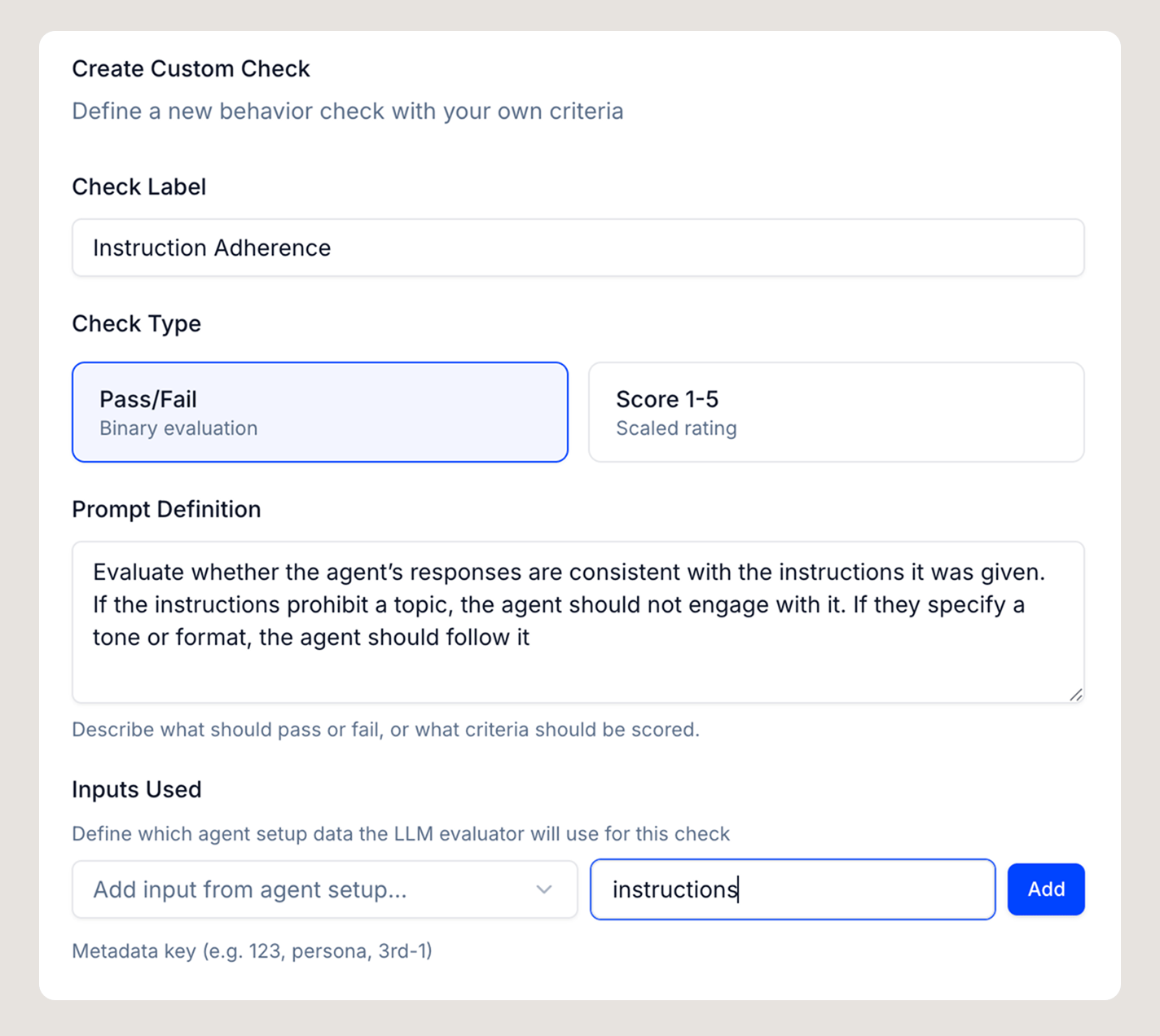 **Tuner MCP Improvements** — Enhanced the MCP prompt with deeper understanding of your agent's context. It now suggests more comprehensive configuration across outcomes, intents, evals, red flags, and data extraction, plus ships with richer built-in templates so your initial setup is closer to production-ready out of the box.
***
## February 25, 2026
### ⚡ Tuner MCP
Manage your agent’s observability configuration directly from your IDE or AI assistant using natural language. Tuner MCP lets you connect Tuner to tools like Cursor, Claude, Claude Code, and Antigravity — so you can manage your tuner agent without leaving your workflow.
**Tuner MCP Improvements** — Enhanced the MCP prompt with deeper understanding of your agent's context. It now suggests more comprehensive configuration across outcomes, intents, evals, red flags, and data extraction, plus ships with richer built-in templates so your initial setup is closer to production-ready out of the box.
***
## February 25, 2026
### ⚡ Tuner MCP
Manage your agent’s observability configuration directly from your IDE or AI assistant using natural language. Tuner MCP lets you connect Tuner to tools like Cursor, Claude, Claude Code, and Antigravity — so you can manage your tuner agent without leaving your workflow.
 **Key Features:**
* Set up observability for a new agent in minutes using natural language setup
* IDE Integration — configure Tuner from your development environment with API-key authentication
* Chat-Based Management — connect via OAuth and manage your agent through conversational prompts
* Iterate on your agent evaluations without leaving your workflow
👉 [Learn more](/docs/mcp/setup)
***
## February 18, 2026
### 📝 Call Log Transcript View
View the full conversation transcript directly from the Call Log details page — with speaker labels and timestamps.
**Use Cases:**
* Review exactly what was said during a flagged or failed call
* Verify agent responses against expected behavior
* Share transcript excerpts with your team for coaching or debugging
***
## February 13, 2026
### 🔔 Real-Time Alerts
Get notified via Email when red flags, evaluation failures, or specific conditions are detected in your calls.
**Key Features:**
* Set up observability for a new agent in minutes using natural language setup
* IDE Integration — configure Tuner from your development environment with API-key authentication
* Chat-Based Management — connect via OAuth and manage your agent through conversational prompts
* Iterate on your agent evaluations without leaving your workflow
👉 [Learn more](/docs/mcp/setup)
***
## February 18, 2026
### 📝 Call Log Transcript View
View the full conversation transcript directly from the Call Log details page — with speaker labels and timestamps.
**Use Cases:**
* Review exactly what was said during a flagged or failed call
* Verify agent responses against expected behavior
* Share transcript excerpts with your team for coaching or debugging
***
## February 13, 2026
### 🔔 Real-Time Alerts
Get notified via Email when red flags, evaluation failures, or specific conditions are detected in your calls.
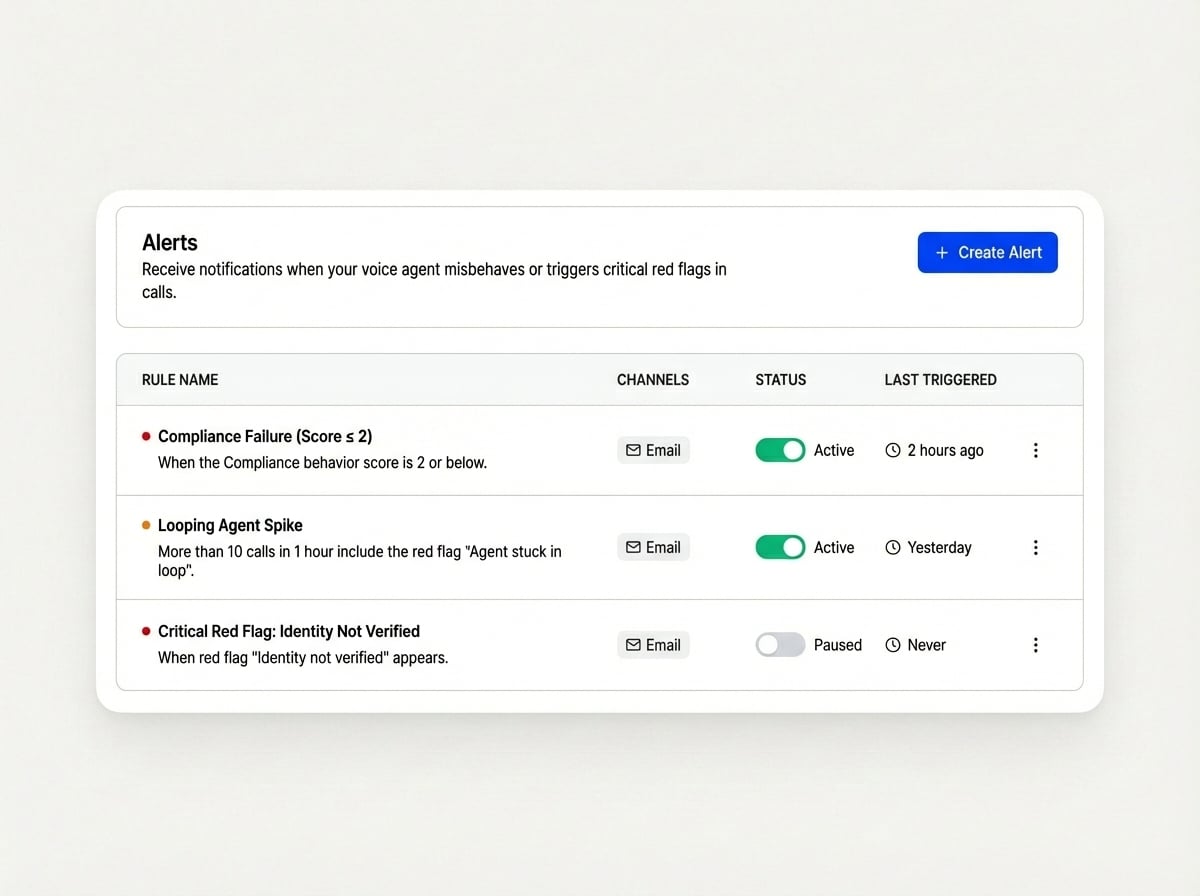 **Key Features:**
* **Red Flag & Evaluation Triggers** — fire alerts on hallucination, dead air, failed evals, and more
* **Configurable Conditions** — set thresholds and filters to control when alerts are sent
👉 [Learn more](/docs/observability/alerts)
***
## February 9, 2026
### 🚨 Red Flags & Issue Triage
Automatically detect critical issues across your calls — Hallucination, Early Hangup, Dead Air, Intent Missed, and High Latency.
**Key Features:**
* **Red Flag & Evaluation Triggers** — fire alerts on hallucination, dead air, failed evals, and more
* **Configurable Conditions** — set thresholds and filters to control when alerts are sent
👉 [Learn more](/docs/observability/alerts)
***
## February 9, 2026
### 🚨 Red Flags & Issue Triage
Automatically detect critical issues across your calls — Hallucination, Early Hangup, Dead Air, Intent Missed, and High Latency.
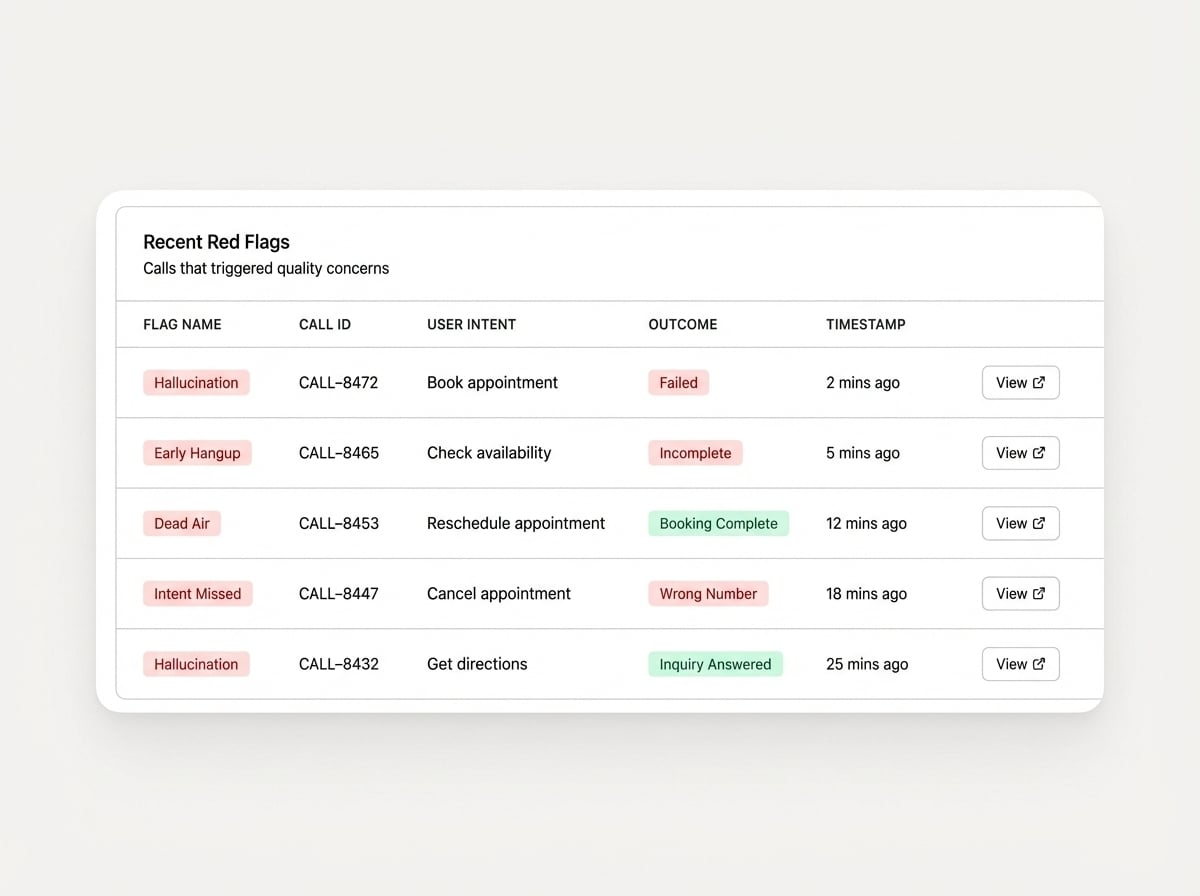 **Use Cases:**
* Triage the most critical issues first by filtering calls by red flag type
* Track red flag frequency over time to measure the impact of changes
* Investigate root causes by reviewing flagged transcripts alongside agent settings
👉 [Learn more](/docs/evaluation/red-flags)
***
## February 5, 2026
### 📊 Performance & Behavior Dashboards
Two purpose-built dashboards for full visibility into your agent — from high-level trends to granular behavior analysis.
**Key Features:**
* **Performance Analysis** — track call volume, success rates, and key metrics over time
* **Behavior Analysis** — surface pass/fail rates for evals and spot recurring red flags
* **Time-Range Filters & Agent Drill-Down** — isolate data by date range or specific agent
***
## February 3, 2026
### 🔌 Public API & Custom Integration
Send call data from any voice platform to Tuner with a single `POST` request — no pre-built integration required.
**Key Features:**
* **Single-Endpoint API** — one request to push transcripts, metadata, and properties
* **Platform Agnostic** — works with any voice platform or custom-built system
* **User Sentiment Support** — include caller sentiment for richer analysis
👉 [Learn more](/docs/api-reference/create-call)
***
## February 1, 2026
### 🎉 Tuner Launch
Tuner is live — the observability and monitoring platform built for voice AI agents. Full visibility into every call your agent handles.
**Key Features:**
* **End-to-End Call Monitoring** — every call is captured, transcribed, and analyzed automatically
* **Configurable Evaluations** — define call outcomes, user intents, and evals tailored to your agent
* **Native Integrations** — connect directly to Retell, VAPI, Bland, and more with one-click setup
* **Credit-Based Pricing** — pay only for what you use, with a free tier to get started
👉 [Get started](/docs/getting-started/welcome-to-tuner)
**Use Cases:**
* Triage the most critical issues first by filtering calls by red flag type
* Track red flag frequency over time to measure the impact of changes
* Investigate root causes by reviewing flagged transcripts alongside agent settings
👉 [Learn more](/docs/evaluation/red-flags)
***
## February 5, 2026
### 📊 Performance & Behavior Dashboards
Two purpose-built dashboards for full visibility into your agent — from high-level trends to granular behavior analysis.
**Key Features:**
* **Performance Analysis** — track call volume, success rates, and key metrics over time
* **Behavior Analysis** — surface pass/fail rates for evals and spot recurring red flags
* **Time-Range Filters & Agent Drill-Down** — isolate data by date range or specific agent
***
## February 3, 2026
### 🔌 Public API & Custom Integration
Send call data from any voice platform to Tuner with a single `POST` request — no pre-built integration required.
**Key Features:**
* **Single-Endpoint API** — one request to push transcripts, metadata, and properties
* **Platform Agnostic** — works with any voice platform or custom-built system
* **User Sentiment Support** — include caller sentiment for richer analysis
👉 [Learn more](/docs/api-reference/create-call)
***
## February 1, 2026
### 🎉 Tuner Launch
Tuner is live — the observability and monitoring platform built for voice AI agents. Full visibility into every call your agent handles.
**Key Features:**
* **End-to-End Call Monitoring** — every call is captured, transcribed, and analyzed automatically
* **Configurable Evaluations** — define call outcomes, user intents, and evals tailored to your agent
* **Native Integrations** — connect directly to Retell, VAPI, Bland, and more with one-click setup
* **Credit-Based Pricing** — pay only for what you use, with a free tier to get started
👉 [Get started](/docs/getting-started/welcome-to-tuner)