

Documentation Index
Fetch the complete documentation index at: https://docs.usetuner.ai/llms.txt
Use this file to discover all available pages before exploring further.
Overview
Connect a Dograh voice workflow to Tuner in two halves: wire the workflow in Dograh, then align a Custom API agent in Tuner and paste the same identifiers back into Dograh.Estimated time: ~10 minutes
You need: a Dograh workflow and a Tuner account.
Step 1: Add the Tuner node (Dograh)
- Open the voice workflow you want to observe.
- Use Add node (top of the canvas) and open the right-hand node panel.
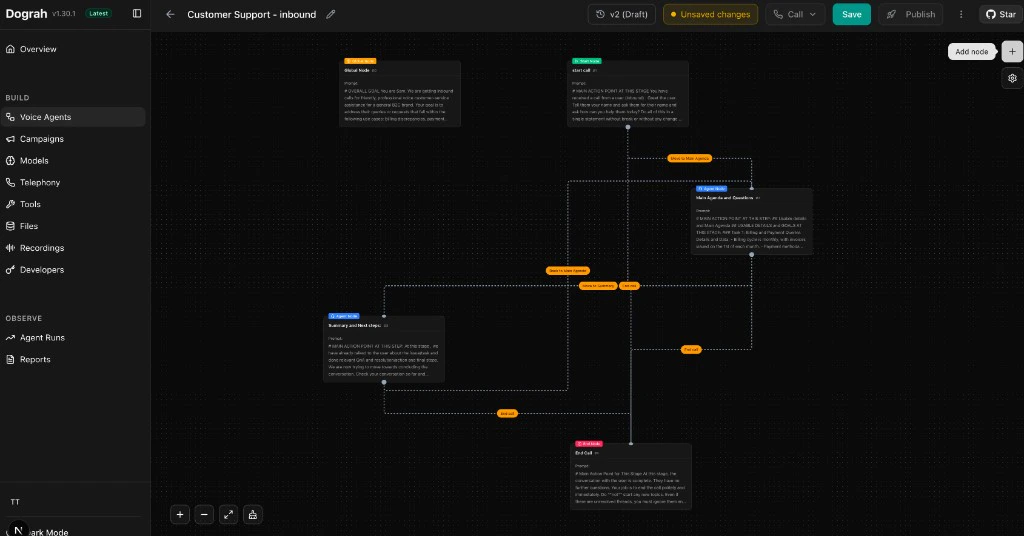
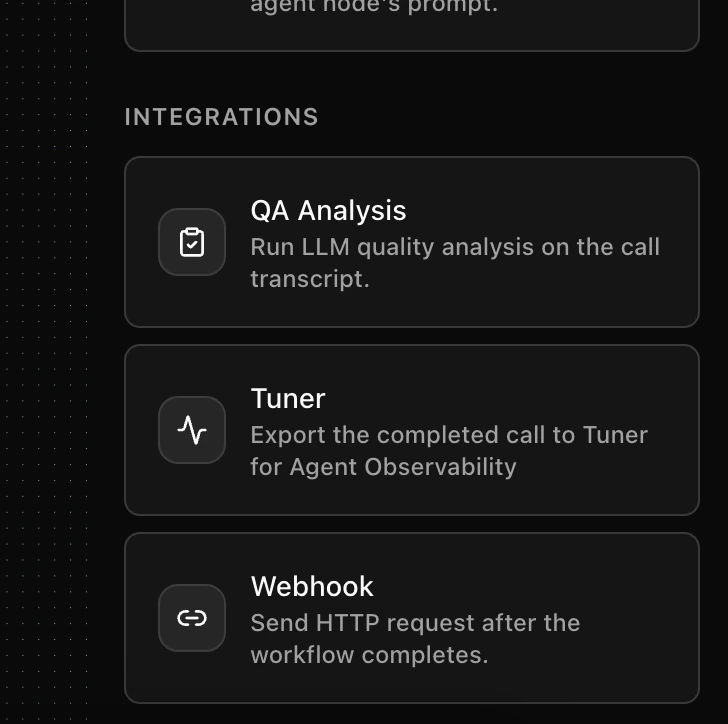
- Scroll to Integrations and locate QA Analysis, Tuner, and Webhook.
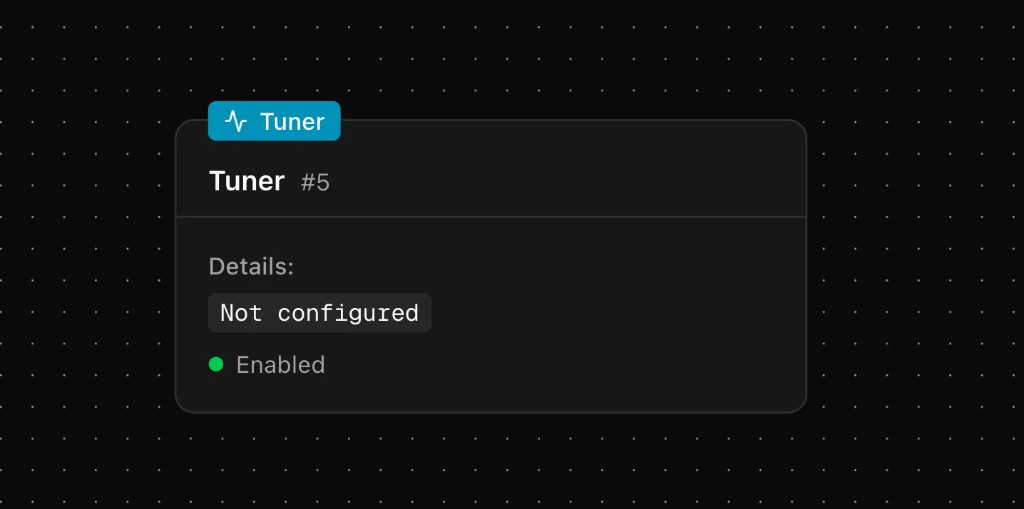
- Select Tuner. A node appears with Not configured — you will configure it in Step 4, after Steps 2 and 3.
Step 2: Create your Tuner agent
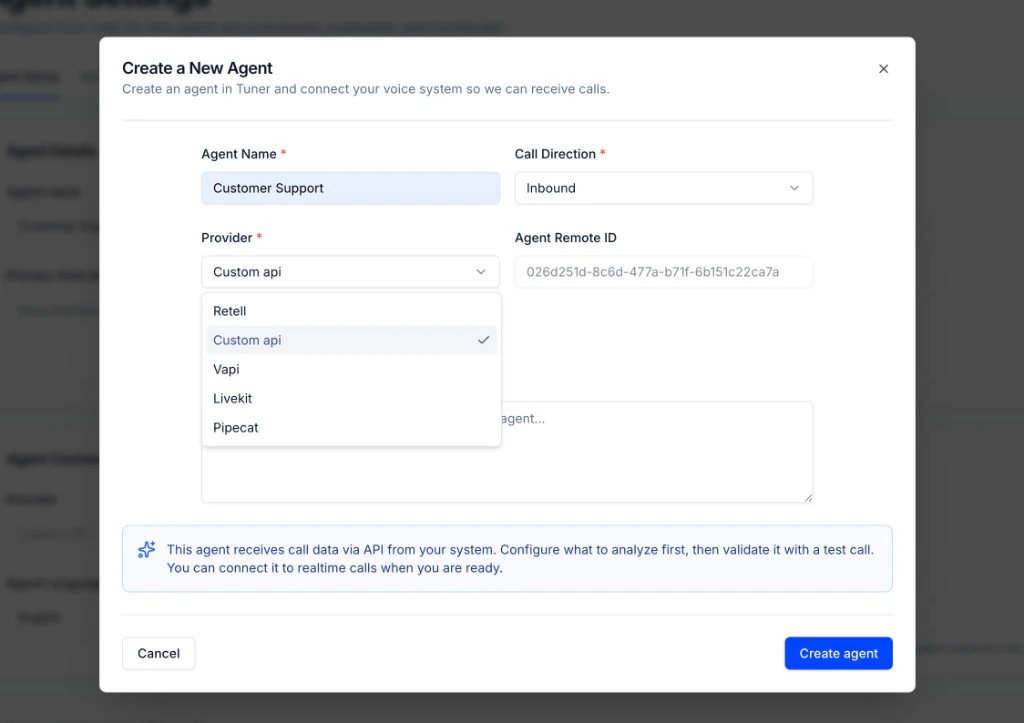
- In app.usetuner.ai, click + Create New Agent.
- In Create a New Agent, set:
Field What to enter Agent Name Name that matches your Dograh workflow (e.g. Customer Support). Call Direction Inbound or Outbound — match production. Provider Custom API (Dograh pushes call data via Tuner’s ingestion path — not Retell, Vapi, LiveKit, or Pipecat). Agent Remote ID Assigned after you click Create agent. Primary Goal Optional brief description of the agent. - Click Create agent.
Step 3: Collect credentials from Tuner
You need exactly three values for the Dograh Edit Tuner panel:| Paste into Dograh | Where to copy in Tuner |
|---|---|
| Tuner Agent ID | Agent Settings → Agent Connection → Agent Remote ID |
| Tuner Workspace ID | Workspace Settings → General Settings → Workspace ID (numeric) |
| Tuner API Key | Workspace Settings → Tuner API Key — use the eye icon to reveal, or regenerate if needed |
Agent Remote ID
Open Agent Settings for your agent and copy Agent Remote ID.
Workspace ID and API key
Open Workspace Settings. Copy Workspace ID, then locate Tuner API Key on the same page.
Step 4: Configure the Tuner node (Dograh)
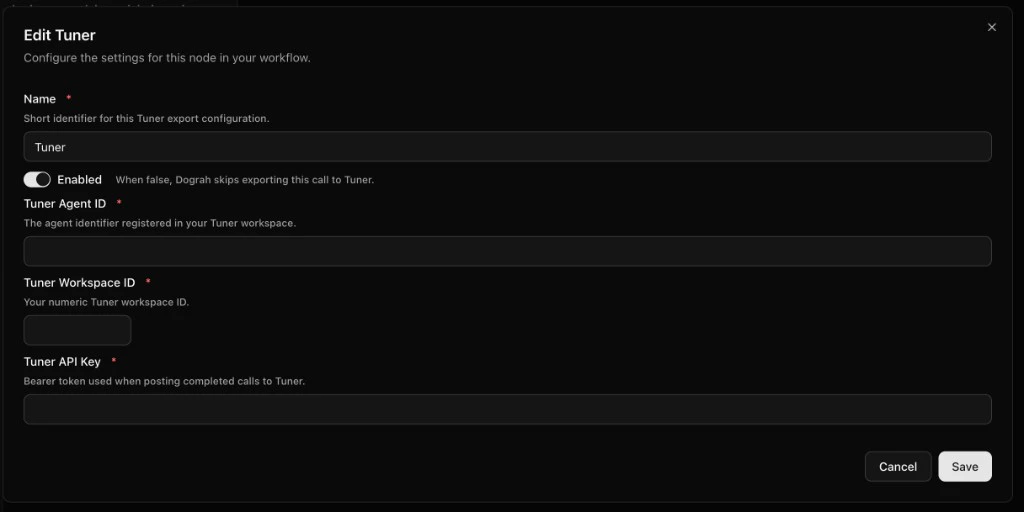
- Select the Tuner node on your canvas → Edit Tuner opens.
- Confirm Enabled is on (off = Dograh skips export).
- Fill in:
- Name — Optional label (default Tuner is fine).
- Tuner Agent ID — Agent Remote ID from Step 3.
- Tuner Workspace ID — numeric ID from Step 3.
- Tuner API Key — from Step 3.
- Click Save.
Step 5: Save, publish, verify
- In Dograh, Save the workflow.
- Publish — drafts won’t send production traffic to this export.
- Run a short test call.
- In Tuner, open Call Logs. The session should arrive within moments with transcript and metadata.
Troubleshooting
Calls not appearing in Call Logs
Calls not appearing in Call Logs
- Enabled: Tuner node’s Enabled toggle is on.
- Copy/paste: No leading or trailing spaces on Agent ID, Workspace ID, or API key.
- Published: Workflow is published, not draft-only.
- Provider: The Tuner agent is Custom API (Dograh exports through this ingestion path).